


Contents:
- What is sensory integration?
- What does an SI diagnosis involve?
- Who carries out the diagnostic process for SI disorders?
- What stages does the procedure involve?
- Diagnosis and treatment of SI at the Dialog Centre for Children and Families – standardised diagnostic tools
- At what age is it best to carry out an SI assessment?
- Bibliography
- Related articles
What is sensory integration?
Sensory integration refers to the process by which the nervous system receives sensory stimuli and utilises them in everyday functioning. Thanks to this, the body is able to respond appropriately to sounds, sights, touch, movement, taste, smell and signals from the motor system.
But what happens when certain aspects of this process are disrupted? The symptoms associated with this do not go unnoticed by parents. In such situations, parents usually start looking for support.
What does an SI assessment involve? Who carries it out? How many stages does it consist of? We answer these and many other questions that parents most commonly have below.
Do you need some help?
Sensory Integration Assessment at the Dialog Centre for Children and Families
We assess how a child processes sensory stimuli — and draw up a personalised support plan tailored to their sensory profile.
What does an SI diagnosis involve?
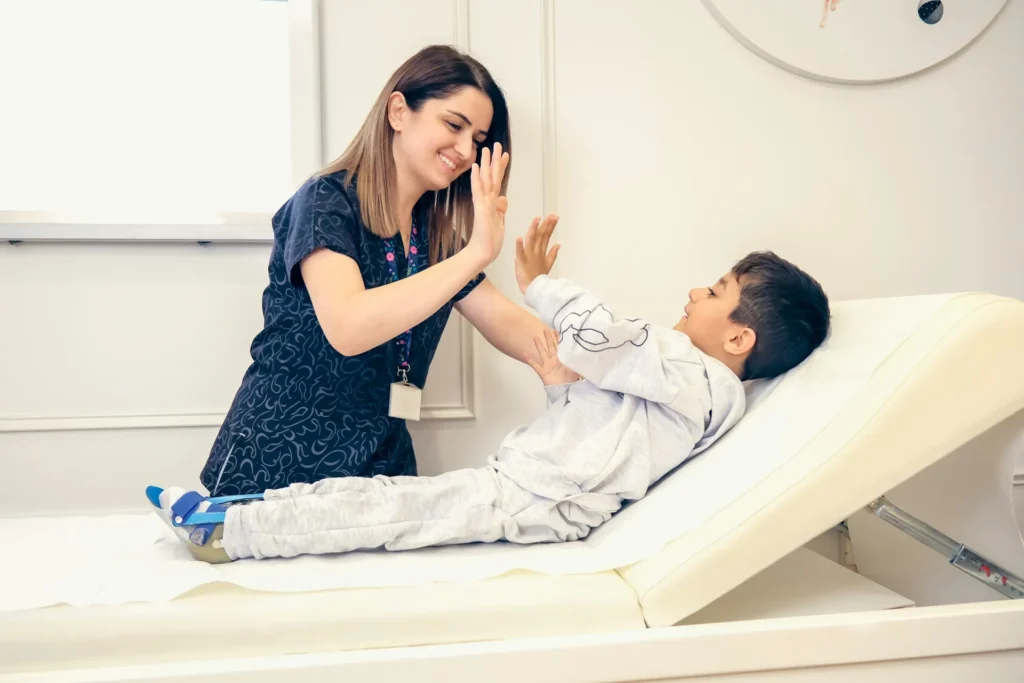
The diagnostic process for sensory integration disorders consists of stages during which the specialist is able to observe how the child perceives sensory stimuli and how they use them in everyday situations.
During the assessment, the senses of sight, hearing and touch, proprioception (deep sensation) and the vestibular system – which is responsible for balance – are examined. Where appropriate, responses to taste and smell are also assessed. The diagnostician checks whether the child’s responses to various sensory stimuli are consistent with the developmental expectations for their age.
During a sensory integration assessment, the specialist gathers information about the child. Using various methods (tasks, exercises and clinical observation), they determine whether the young patient:
- responds in a manner appropriate to the intensity and nature of the stimulus,
- is able to use sensory information whilst moving, playing and learning,
- It utilises various sensory inputs simultaneously.
The assessment provides parents with an overview of their child’s overall sensory functioning. It includes information on the child’s strengths and areas where support is needed. The results of the assessment show whether the behaviours observed at home and at nursery fall within the normal range of development or indicate difficulties in the process of sensory integration. The therapist analyses the information gathered and, on this basis, draws up a professional report, which forms the basis for further action – the initiation of appropriate therapy.
What is the procedure for diagnosing sensory integration disorders?
A whole team of specialists is involved in the diagnostic process. Parents who notice that their child is experiencing difficulties must be aware that identifying the cause requires time, patience and commitment.
A single appointment with a specialist and a discussion with the parents are not sufficient to assess whether sensory integration is developing normally. Only a multi-stage assessment and careful observation of the child make it possible to understand how the child responds to different types of stimuli.
When making a diagnosis, it is important to analyse immediate reactions, but also to compare them with behaviours that recur during subsequent sessions. Only in this way can the diagnostician interpret the child’s development in a reliable and appropriate manner.
Do you need some help?
Sensory Integration Assessment at the Dialog Centre for Children and Families
We assess how a child processes sensory stimuli — and draw up a personalised support plan tailored to their sensory profile.
Who carries out the diagnostic process for SI disorders?
More than one specialist is involved in the process of diagnosing sensory integration disorders. The most important person is the sensory integration therapist. This is the specialist who guides parents or carers through every stage of the entire process.
Depending on the child’s needs, other specialists may also be involved in the process:
- child psychologist,
- speech and language therapist,
- physiotherapist,
- paediatric neurologist.
The Dialog Centre for Children and Families employs experienced experts who are qualified in various fields. In addition to specialising in a specific area of patient care, each specialist holds the necessary certificates authorising them to plan and carry out interventions for SI disorders.
What stages does the procedure involve?
At the Centre, the whole process consists of four stages – each of which takes place during a separate session.
Stage 1 – Initial interview and consultation
The first step is to speak to the parent. This consultation enables us to gather information about the child’s developmental history – from the time of pregnancy right up to the examination.
- The book discusses the prenatal and perinatal (around the time of birth) periods, the labour process itself, the early stages of motor development, developmental milestones, the emergence of the first language skills, as well as the everyday difficulties that have caught the parents’ attention.
The therapist asks about behaviour at home, at nursery or at school, and about reactions to everyday situations – noise, getting dressed, eating meals and physical play.
The initial consultation has another, very important purpose – to prepare the child’s carers for the subsequent sessions. The specialist explains what the whole procedure will involve, what tasks the child will be given, and how the results will be analysed.
What is important is that even the diagnostic process follows an individualised plan. In the context of personalised care, the term ‘developing a treatment plan’ (once a diagnosis has been made) is more commonly used. We wish to emphasise that the diagnostic process itself also requires a targeted approach to the specific issues faced by each child. Whilst standardised questionnaires are, of course, used in the process, the nature of the assessment itself must be tailored to the needs of the young patient.
At the Dialog Centre for Children and Families, we always ensure that parents understand the entire process and have the opportunity to ask questions before the tests begin.
Stages II and III – observing the child in the sensory integration room
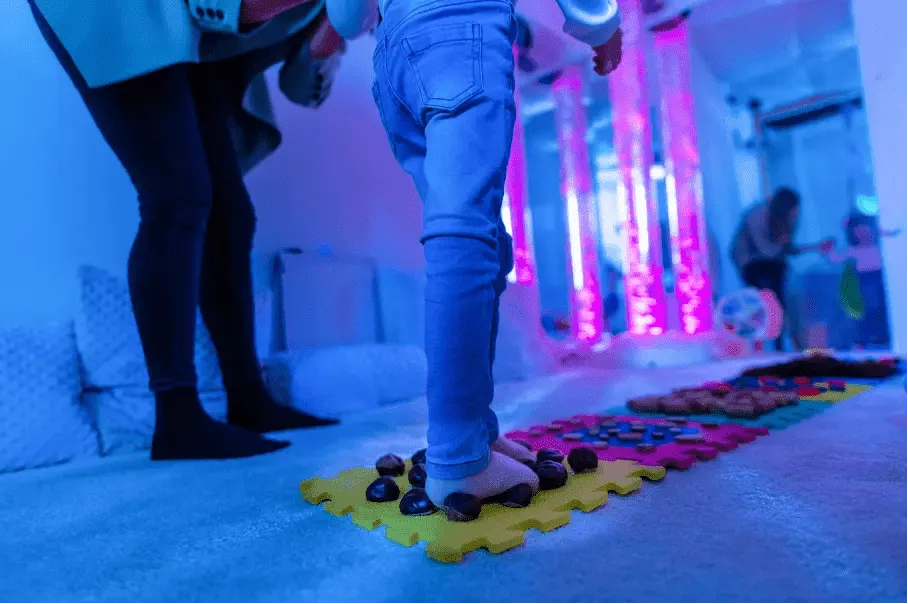
Subsequent sessions take place in a specially designed space. The sensory integration room is equipped with apparatus and materials that enable us to assess the child’s responses to various types of stimuli.
It features climbing frames, balls, mats, obstacle courses and toys with different textures. The space is child-friendly, whilst also enabling a very thorough assessment of neurological processes.
During sessions in the therapy room, the specialist analyses the child’s behaviour in terms of how they process stimuli relating to sound, touch, sight and movement. For each sense, they check whether the responses are appropriate, excessive (hypersensitivity) or diminished (hyposensitivity).
The specialist assesses how the patient uses sensory information in tasks involving movement and coordination – for example, whether they can synchronise their movements with sound, or whether they can maintain their balance when changing body position.
The assessment takes about 45 minutes (sometimes less for younger children) and is repeated at a subsequent appointment to check whether the child’s responses are consistent or vary depending on the situation. The therapist notes their observations, analysing body language, how the child tackles tasks, their concentration and level of engagement.
Stage IV – summarising the assessment and preparing the report
The final stage is a debriefing session, during which the parent receives a full assessment of the child’s sensory functioning. The therapist discusses the results and presents the conclusions drawn from collaboration with other specialists.
- Parents receive a document which describes the child’s difficulties and highlights their strengths. This information forms the basis for drawing up an individual treatment plan.
In the case of less severe difficulties, the assessment can be regarded as a guide for periodic monitoring of development.
Do you need some help?
Sensory Integration Assessment at the Dialog Centre for Children and Families
We assess how a child processes sensory stimuli — and draw up a personalised support plan tailored to their sensory profile.
Diagnosis and treatment of SI at the Dialog Centre for Children and Families – standardised diagnostic tools
What does it mean to use standardised tests? This term refers to protocols that have been developed on the basis of developmental standards. The Polish Sensory Integration Tests are the most commonly used, as they assess a wide range of a child’s responses.
At the Dialog Centre for Children and Families, we also use international assessment tools (including the Sensory Integration and Praxis Tests, SIPT) – a series of tests that assess how a child responds to movement, distinguishes between different tactile sensations, plans motor activities and processes sensory information.
For younger children, the Test of Sensory Functions in Infants is used, which enables the early identification of deficits and the detection of deviations from the expected rate of development.
At what age is it best to carry out an SI assessment?
A sensory integration assessment can be carried out from early childhood onwards, although the exact method used depends on the child’s age. For very young children up to around 3 years of age, the therapist focuses primarily on interviewing the parent, observing behaviour in natural situations and on simple motor tasks.
- During this period, the same tools are not used as those employed with older children. Nevertheless, the entire procedure can be carried out just as thoroughly, and the specialist is able to draw up an assessment and provide therapeutic guidance for parents.
The diagnostic process is more complex in pre-school and early school-age children – from around 4 to 8 years of age. At this age, children are able to perform more challenging tasks, and the therapist can use questionnaires that enable them to assess specific areas of nervous system functioning in detail. This is also the time when difficulties are most apparent (usually when compared with their peers) and begin to cause delays in learning and in functioning at nursery or school.
However, there is no upper age limit. The diagnosis is also made in older children, teenagers and even adults.
Do you need some help?
Sensory Integration Assessment at the Dialog Centre for Children and Families
We assess how a child processes sensory stimuli — and draw up a personalised support plan tailored to their sensory profile.
Bibliography
- Dąbrowska, M., Olszewska, B., Wydra, M., Kujawińska, M. (2022). Sensory integration in the therapist’s day-to-day work. Poznań: Media Polska.
- Kaniewska-Mackiewicz, E. (2021). The impact of sensory integration disorders on everyday functioning and learning at school. Scientific Journals of the University of Economy, Education-Family-Society series, (5), 91–117.
- Smith, M. C. (2019). Sensory integration: Theory and practice. FA Davis.
Read more
Related articles
Sensory Integration in the Snoezelen Room
A sensory room, also known as a ‘Snoezelen sensory room’ or simply a ‘Snoezelen room’, is a specially designed space intended to create an environment that stimulates the senses whilst providing a sense of safety and relaxation. These rooms are often used when working with people with a range of needs, including those with developmental […]

Psychomotor development (children aged 0–3 years)
A child’s psychomotor development is a process in which the child develops both their mental and motor skills during the first three years of life. This is a period of rapid change, during which a child reaches many milestones in the development of their motor, cognitive and social skills. During the first three years of […]

Snoezelen, or the Sensory Room
1. Introduction The senses form the basis of every person’s development. They provide information about the world around us. Without them, none of us could develop. However, some people are unable to respond to them appropriately, whilst others have lost these abilities due to an accident or illness. For these people, the world can be […]

Auditory processing – What are auditory processing disorders and how can they be treated?
Have you ever wondered how the ability to listen – rather than simply hear – affects a person’s overall development? The ear is not just for hearing. It also stimulates the brain and helps maintain balance. Good hearing plays a key role in the development of a person’s personality. Problems arise when we are dealing […]

Sensory diet
Where does the term ‘sensory diet’ come from? The term ‘sensory diet’ was introduced by Patricia Wilbarger, an American occupational therapist and specialist in sensory integration. Wilbarger developed this concept in the 1990s as part of her work with children and adults who had difficulties with sensory processing. She was a pioneer in this field, […]
Dyslexia – what is it and what causes it?
Diagnosis: the most effective form of educational support for children and young people! Developmental dyslexia is a specific difficulty in learning to read and write that occurs in children with normal intellectual development. It is a neurodevelopmental disorder (with a neurobiological basis) – this means that it stems from abnormalities in the functioning of the […]
Do you need some help?
Sensory Integration Assessment at the Dialog Centre for Children and Families
We assess how a child processes sensory stimuli — and draw up a personalised support plan tailored to their sensory profile.
Book an SI assessment