



Contents:
- 1. An overview of psychomotor development
- 2. Developmental milestones from 0 to 3 years
- Here are some developmental milestones for babies up to three months old:
- Here are some developmental milestones for babies aged between 3 and 6 months:
- Here are some developmental milestones for children aged between 6 and 12 months:
- Here are some developmental milestones for children aged between 12 and 18 months:
- Here are some developmental milestones for children aged between 18 and 24 months:
- Here are some developmental milestones for children aged between 24 and 36 months (2–3 years):
- 3. Developmental leaps
- 4. The most important developmental milestones in children
- 5. Developmental leaps – the child’s difficulties
- 6. Developmental delays – when should you see a specialist?
- 7. The psychological development of a young child
- 8. When should you see a psychologist?
- 9. Frequently Asked Questions (FAQ)
- Author:
- Bibliography:
- Related articles
A child’s psychomotor development is a process in which the child develops both their mental and motor skills during the first three years of life.
This is a period of rapid change, during which a child reaches many milestones in the development of their motor, cognitive and social skills.
During the first three years of life, a child learns through interaction with their environment and by experiencing various stimuli. They observe, play, form relationships with their carers and explore their surroundings.
Research shows that the first three years of a child’s life are the most important period in a person’s life.
1. An overview of psychomotor development
A child’s psychomotor development from birth to the age of three is extremely important for their future abilities – both physical and mental – and involves many significant stages. For the child themselves, this is an extremely intense period, which often causes discomfort and a whole range of different emotions. Below you will find a general overview of psychomotor development:
Newborn (0–3 months):
- The child begins to show reactions to auditory and visual stimuli.
- Gradually, they learn to control their movements, and their muscles begin to get stronger.
- The development of fine motor skills, such as grasping with the fingers, begins.
Infant (4–6 months):
- The child gains greater control over their head and can hold it up on their own.
- The process of rolling from the front to the back and vice versa begins.
- They begin to explore objects by touching them and put them in their mouths.
Beginners’ mobile (7–9 months):
- The child starts to crawl or creep in order to move around.
- Fine motor skills develop, enabling the child to grasp smaller objects.
- They may start to sit up on their own.
The early stages of walking (10–12 months):
- The child is starting to sit down and stand up on their own, using a support.
- They are starting to learn to walk, holding onto furniture or someone’s hand.
- Fine motor skills are developing, and the child is trying to use a fork and spoon to eat.
Advanced motor skills (13–18 months):
- The child starts walking unaided.
- He can climb the stairs whilst holding onto the banister.
- It helps to develop manual skills, such as putting items into and taking them out of containers.
Motor independence (19–24 months):
- The child becomes more confident when walking and running.
- He can throw the ball and try to catch it with both hands.
- He is starting to try to dress himself and use cutlery.
Motor coordination (25–36 months):
- The child develops motor skills such as jumping, standing on one leg and walking along a line.
- It can run, avoid obstacles and carry out simple motor tasks.
- Fine motor skills are becoming increasingly precise, enabling the child to draw and do jigsaw puzzles.
Do you need some help?
Assessment of a young child’s development at the Dialog Centre for Children and Families
Early assessment of a child’s development (3 months – 3 years) — speech, motor skills, emotions and relationships. The sooner we identify any difficulties, the more effective the support will be.
2. Developmental milestones from 0 to 3 years
Every parent or carer asks themselves: is everything all right with my child? Are they healthy? Are they developing properly? These are perfectly normal questions that concern many parents, especially at the start of their parenting journey. The desire to ensure your child’s proper development and wellbeing is natural. Here are a few key points that may help you assess whether your child’s development is progressing as expected:
Here are some developmental milestones for babies up to three months old:
Your baby can hold their head up for a few seconds when supported in a sitting position. They prop themselves up on their forearms when lying on their tummy and turn their head towards the source of a sound. They try to grasp objects within reach and hold them for a short time. They focus their gaze on objects and people’s faces – provided they are close by. They are fascinated by objects in contrasting colours. They often look at their own hands and fingers. They smile in response to being spoken to. They may also respond by making sounds. Even at this young age, they are already beginning to make eye contact and smile at their carers, and express their needs through crying, laughing and making sounds.
Here are some developmental milestones for babies aged between 3 and 6 months:
Your baby can now hold their head upright when supported in a sitting position. They are becoming increasingly steady on their forearms when lying on their tummy. They can roll from their tummy onto their back and vice versa. They are gaining more control over their hands and are starting to reach for objects to grasp them. They enjoy objects that offer a variety of sensory experiences. They focus their gaze on smaller objects and can follow their movements. They are beginning to recognise the faces of their carers. They are interested in the sounds of their own voice and experiment with them. The child begins to form an emotional bond with their carers and may be more aware of their surroundings. They also start to explore objects by putting them in their mouth.
Here are some developmental milestones for children aged between 6 and 12 months:
During this stage of development, your little one gains greater control over their muscles and can sit up steadily without support. They begin to make their first attempts at standing up, holding onto furniture or someone’s hand. Your child will try to crawl or creep to move around. The precision of their hand movements improves. Your child begins to use their fingers to manipulate objects and shows an interest in illustrations in books and pictures on objects. They recognise and respond to their own name and understand simple commands such as ‘give me that’. A one-year-old shows greater independence and wants to explore their surroundings on their own, which may lead to surprise or frustration at not yet having the necessary skills. They may show fear of strangers and feel upset or even distressed when their carers are out of sight. They respond to praise, encouragement and instructions. They begin to try to stack objects or pour from one container into another.
Here are some developmental milestones for children aged between 12 and 18 months:
Your little one can now walk unaided and can climb stairs with help from their carers. They may try to climb onto low pieces of furniture. Their fine motor skills are becoming increasingly precise – they are trying to use cutlery to eat. When looking at books, they recognise and point to objects in the pictures. They try to imitate their carers in simple activities. A one-and-a-half-year-old understands more and more words and phrases, so they are starting to say their first words or make single sounds to communicate and express their needs. Manipulative toys and puzzles become more interesting, and the child tries to solve them. They begin to recognise and name simple objects, animals and colours.
Here are some developmental milestones for children aged between 18 and 24 months:
Your child is walking unaided and has probably learnt to run by now. They can also – with a bit of help – climb stairs. They may try to jump or stand on one leg. Your little one has a wider vocabulary and is starting to use simple sentences. They understand simple instructions and follow them. At the same time, they want to be more independent and often resist following instructions. They show an interest in playing with other children. They can eat independently using a spoon and fork and are starting to try to get dressed and undressed by themselves.
Here are some developmental milestones for children aged between 24 and 36 months (2–3 years):
Your child is now walking steadily and can run, jump and climb. They can go up and down the stairs on their own, holding onto the banister. They can catch a ball with both hands, are trying to draw simple lines, and recognise basic colours. Your little one has expanded their vocabulary and can now form simple sentences. They are forming social bonds with their peers and are starting to take part in simple group games. They are starting to develop their imagination and engage in symbolic play, for example, by pretending to be a character or using objects for role-play.
Do you need some help?
Assessment of a young child’s development at the Dialog Centre for Children and Families
Early assessment of a child’s development (3 months – 3 years) — speech, motor skills, emotions and relationships. The sooner we identify any difficulties, the more effective the support will be.
3. Developmental leaps
Developmental leaps are periods of intensive development and skill acquisition in infants and young children. During developmental leaps, a child goes through a challenging time characterised by rapid changes in their cognitive, motor, emotional and social skills.
Developmental leaps are linked to a child’s brain development. During these periods, there is a reorganisation and growth of neural connections, which leads to the acquisition of new skills. A child may display increased activity, be more restless, less emotionally stable and show a greater need for attention and care from their carers.
During a developmental leap, a child may also show certain signs of regression, such as increased crying, difficulty falling asleep, changes in eating habits or a greater need for physical closeness. They may be more whingey and harder to soothe. It is also perfectly natural for them to temporarily lose skills they have already learnt, in order to acquire new ones.
Developmental leaps are a natural part of a child’s development and indicate progress in their development. Following a developmental leap, a child usually acquires new skills, such as walking, talking or feeding themselves. It is important to be more patient and attentive during this challenging time – for both the child and their parents. The child needs extra emotional and physical support.
Developmental leaps can occur at different times and in different areas of a child’s development. Some of these are well known and occur at specific ages, such as the developmental leap around the 8th week, the 4th month, the 8th month, and so on. However, each child may experience developmental leaps at slightly different times, as the pace of development can vary.
It is worth being patient and understanding, bearing in mind that developmental leaps are only temporary phases and usually subside after a few days or weeks.
Do you want to make sure your child is developing as expected? Take a look at our diagnostic services and book an appointment!
4. The most important developmental milestones in children
A developmental leap at around 4–6 weeks of age:
- The child is becoming more alert and responsive to their surroundings.
- Greater eye contact with carers.
- More smiles and expressions of emotion.
A developmental leap at around 4–6 months of age:
- The child begins to develop motor skills such as crawling, sitting up unaided and attempting to walk.
- Interest in their surroundings and exploration is growing.
- More verbal communication and gesturing.
A developmental leap at around 8–10 months of age:
- The child begins to develop fine motor skills, such as picking up smaller objects and trying to feed themselves.
- The child develops the ability to move vertically and attempts to stand up unaided.
- A greater interest in social interaction.
A developmental leap at around 12–15 months:
- The child begins to develop the ability to walk and move around independently.
- The ability to use simple words and understand simple instructions is developing.
- Greater exploration and curiosity about the world.
Do you need some help?
Assessment of a young child’s development at the Dialog Centre for Children and Families
Early assessment of a child’s development (3 months – 3 years) — speech, motor skills, emotions and relationships. The sooner we identify any difficulties, the more effective the support will be.
5. Developmental leaps – the child’s difficulties
Developmental leaps are periods of intensive growth during which a child acquires new skills and reaches further developmental milestones. During these periods, children may display behaviour that could be considered challenging. To help you better understand why your child is behaving differently, we explain the challenges a young child faces during developmental leaps:
Physical changes: During growth spurts, a child undergoes physical changes, such as the growth of muscles, bones and the nervous system. These changes can cause discomfort, tiredness and instability, which may affect the child’s well-being and behaviour.
Increased developmental needs: During developmental leaps, a child works hard to acquire new skills, which requires a lot of energy and effort. Children may be more tired, or, conversely, more hyperactive, meaning they will need more sleep and food.
Emotional changes: Developmental leaps are associated with emotional changes in a child. A child may be more restless, irritable, tearful or quiet during these periods. Increased emotional sensitivity may stem from difficulties in coping with new experiences and skills.
Increased need for support: During developmental leaps, a child may feel a greater need for closeness, care and support from their parents or carers. At such times, the little one is more keen to be cuddled and to breastfeed for comfort and a sense of security in the face of the new challenges they are encountering.
It is important for parents and carers to be aware of these changes and to show their child extra affection, patience and understanding during developmental leaps. It is also important to provide the child with appropriate support and stimulation to help them acquire new skills.
6. Developmental delays – when should you see a specialist?
Delays in the development of skills can affect various areas, such as speech and language, motor skills, sensory perception, social and emotional skills, and cognitive skills. If you notice any concerns regarding these areas of your child’s development, or if there is anything that worries you, it is worth consulting the relevant specialist. A paediatrician, child psychologist, speech and language therapist, occupational therapist or paediatric neurologist will carry out an appropriate developmental assessment and suggest suitable interventions or therapy to help support your little one’s continued development. Remember that the sooner you take action, the better it will be for your child’s development. Here are a few signs that may indicate developmental delays. Below you’ll find a comprehensive list to help you resolve any concerns.
Speech and language
Speech and language delays are relatively common developmental issues in children. If your child has not started speaking by the expected age, or has not begun to use words in a way appropriate for their age, this may indicate that they have a delay in this area. Furthermore, such a delay may also manifest itself through:
- Difficulties with pronouncing sounds: A child may find it difficult to pronounce certain sounds, or these sounds may be unclear to others.
- Limited vocabulary: The child may use only a limited number of words or find it difficult to find the right words to express their thoughts.
- Difficulties in understanding verbal communication: The child may find it difficult to understand instructions, questions or commands.
- Difficulties with social communication: The child may have difficulty establishing and maintaining eye contact, understanding gestures, reading body language or understanding the social rules associated with communication.
Motor skills
Delays in a child’s motor skills may be noticeable in various areas of motor development. If your little one has not acquired the expected motor skills by a certain age – for example, if they cannot sit up unaided, crawl, walk, throw a ball or catch objects – this may indicate a motor delay. Other behaviours indicating motor development issues include:
- Difficulties with motor coordination: The child may find it difficult to perform precise movements, such as drawing, writing, rolling over, tying shoelaces or fastening buttons.
- Clumsiness: The child often trips, drops things, has difficulty keeping their balance or moves awkwardly.
- Difficulties with graphomotor skills: A child may find it difficult to control the movement of their hand whilst writing, drawing, colouring or carrying out other activities involving the use of writing implements.
- Delayed development of fine motor skills: The child has difficulty grasping objects, using cutlery, doing up buttons, tying shoelaces, etc.
Do you need some help?
Assessment of a young child’s development at the Dialog Centre for Children and Families
Early assessment of a child’s development (3 months – 3 years) — speech, motor skills, emotions and relationships. The sooner we identify any difficulties, the more effective the support will be.
Sensory perception
Delays in this area can affect the way a child processes and responds to sensory stimuli, such as touch, sound, smell, taste, sight and proprioception (the sense of body position and movement). A child with sensory processing difficulties may react excessively or inappropriately to certain stimuli. For example, they may show hypersensitivity to sounds or touch, avoid certain textures or smells, or have a low pain threshold. On the other hand, they may be under-stimulated – in which case they may try to cuddle tightly, rub against things, or even pinch or hit. Other behaviours that may be cause for concern include:
- Difficulties with sensory integration: A child may have difficulty processing and integrating various sensory stimuli. For example, they may have difficulty coordinating their vision and movement, difficulty distinguishing and identifying tactile stimuli, and difficulty recognising and locating sounds.
- Anxiety or aversion to certain stimuli: A child may experience anxiety, fear or aversion towards specific sensory stimuli, leading them to avoid situations or places associated with these stimuli. For example, they may avoid places with loud noises, crowds or strong smells.
- Difficulties in regulating emotions: The child may find it difficult to regulate their own emotions, particularly in situations involving sensory stimuli. They may display excessive excitability, frustration, anxiety or withdrawal in response to certain sensory stimuli.
Social skills
A delay in this area of development can manifest itself in various ways in children. Some children do not like making eye contact or do not feel the need to do so, whilst others do not understand social rules. Here are a few signs that may indicate a delay in this area:
- Lack of understanding of social cues: A child may find it difficult to understand social cues, such as pointing, waving goodbye, nodding, etc.
- Limited communication skills: The child may find it difficult to express their thoughts, feelings and needs in a way that others can understand. They may have a limited vocabulary, struggle to form sentences, or lack the ability to strike up a conversation, etc.
- Difficulties with empathy and recognising emotions: A child may find it difficult to understand and recognise emotions in other people, which may lead to difficulties in responding empathetically to the needs of others.
Cognitive skills
A delay in this area of development may affect a child’s ability to think, learn, solve problems and process information. A child with cognitive difficulties may find it hard to concentrate and focus their attention, or may have limited memory – that is, the ability to remember information – both long-term and short-term.
- Difficulties in understanding abstract concepts: A child may find it difficult to understand abstract concepts such as time, cause and effect, spatial relationships, etc.
- Limited problem-solving skills: The child may find it difficult to identify and solve problems. They may struggle to anticipate the consequences of their actions, come up with alternative solutions, or plan the steps needed to achieve a goal.
- Limited ability to process information: A child may find it difficult to process and organise information, which can lead to difficulties with learning, reading, writing or maths.
If any of the symptoms and behaviours listed above apply to your child, it is worth consulting a child psychologist or a special needs teacher. A specialist will assess your child’s abilities and may recommend appropriate therapeutic strategies or educational programmes to help develop the skills that are affected.
Do you need some help?
Assessment of a young child’s development at the Dialog Centre for Children and Families
Early assessment of a child’s development (3 months – 3 years) — speech, motor skills, emotions and relationships. The sooner we identify any difficulties, the more effective the support will be.
7. The psychological development of a young child
A young child’s psychological development is an extremely important aspect of their overall development. It encompasses many different areas, such as thinking, emotions and perceptions of themselves and others.
Sensory perception refers to the way in which we receive and interpret sensory information from our surroundings using our senses. Our senses – sight, hearing, touch, taste and smell – enable us to gather data from the outside world and transmit it to our brain in the form of sensory stimuli.
Early psychological development involves the ability to process this information. The child becomes increasingly sensitive to various external stimuli and learns to recognise and interpret them.
Sensory perception is crucial to our ability to communicate, orientate ourselves in our surroundings, make decisions and adapt to changing conditions. Each sense contributes to our overall experience of the world and influences our day-to-day functioning.
Cognitive development refers to the changes and progress in skills such as thinking, learning, reasoning, memory and problem-solving that occur throughout a person’s life. Early experiences and interactions with the environment have a significant impact on a child’s cognitive development. Cognitive development is an individual process, and the pace and sequence of development may vary from child to child. Genetic, environmental and social factors can also influence cognitive development.
Emotional development: The child develops their ability to recognise, express and regulate emotions. Initially, emotions are mainly reactions to basic needs, but gradually the child learns to recognise and name different emotions and to understand their causes and consequences. This aspect is accompanied by many internal conflicts, such as: trust versus mistrust of the carer; autonomy versus shame and doubts about one’s own independence; initiative versus feelings of guilt regarding the achievement of age-appropriate goals (e.g. learning to use the toilet). Of course, a child is unable to name or express these conflicts, but it is worth remembering that such difficult processes are taking place within this little person, which is why it is important to be understanding.
Self-perception and the perception of others refer to the way in which people perceive, interpret and evaluate themselves and other people in their environment. This is a very important part of a child’s development. How a child perceives themselves now and will perceive themselves in the future is based on their inner beliefs, experiences and interpretations of actions and characteristics. As parents are the first ‘mirror’ in which a child sees themselves, it is the parents’ behaviour and words that will shape the child’s internal beliefs about themselves. It is worth remembering, however, that the perception of oneself and others is a dynamic process and may change depending on context, experiences, personal development and therapy. Furthermore, individual differences, such as personality, culture, values and preferences, can influence how we perceive ourselves and others.
Social development refers to the process by which a child acquires the skills, norms, values and social interactions that enable them to function within society. It encompasses the development of communication and cooperation skills, the ability to form relationships with peers and adults, the ability to understand and respond to other people’s emotions, and an understanding of social norms.
Do you need some help?
Assessment of a young child’s development at the Dialog Centre for Children and Families
Early assessment of a child’s development (3 months – 3 years) — speech, motor skills, emotions and relationships. The sooner we identify any difficulties, the more effective the support will be.
8. When should you see a psychologist?
The decision to seek advice from a psychologist for a young child may be justified in various situations. Here are a few signs that may suggest a child needs psychological support:
Emotional difficulties: If a child shows signs of emotional difficulties, such as excessive anxiety, difficulty coping with strong emotions, inappropriate emotional reactions, prolonged low mood or problems regulating their mood, this may be a sign that psychological support is needed.
Behavioural difficulties: If a child is experiencing behavioural difficulties, such as aggressive behaviour, excessive crying, problems with concentration, impulsiveness or difficulties in forming relationships with peers, it is worth consulting a psychologist to understand these difficulties. A psychologist may recommend individual or group therapy, which can be provided as part of social skills training (TUS) sessions.
Developmental issues: If a child shows signs of developmental delays, such as delays in speech, perception, motor skills or social skills, it is advisable to consult a psychologist or a specialist in child development.
Difficulties adapting: There are situations in which a child finds it difficult to adapt to new circumstances or life changes, such as their parents’ divorce, moving house, the loss of a loved one, etc. In such cases, psychological support can help the child to cope with these difficulties.
Traumatic experiences: If a child has experienced trauma, such as abuse, an accident or the loss of a loved one, psychological support will be essential to their recovery and in helping them cope with emotional difficulties.
It is worth remembering that every child develops at their own pace, so the decision to consult a psychologist should be based on the parents’ or carers’ observations and assessment of the situation. If you have any concerns about your child’s development or mental health, it is worth consulting a paediatrician or seeking a referral to a psychologist who specialises in working with children.
9. Frequently Asked Questions (FAQ)
1. What are the stages of a child’s psychomotor development?
The stages of a child’s psychomotor development are: infancy (0–2 years), early childhood (2–6 years), middle childhood (6–12 years) and adolescence (12–18 years). Each stage has its own specific characteristics relating to, amongst other things, motor coordination, speech, perception and social interaction. In this article, we have focused on describing the development of children aged 0–3 years.
2. How can you tell if a child’s psychomotor development is progressing normally?
Normal psychomotor development involves progress in gross motor skills (e.g. sitting, walking), fine motor skills (e.g. grasping, drawing), speech, and cognitive and socio-emotional skills. Comparing a child’s skills with typical developmental milestones can help to assess whether they are developing normally. At Senso Senso, we support parents and monitor children’s development.
3. What are the signs of psychomotor developmental delay in children?
Signs of developmental delay may include difficulties in reaching typical developmental milestones, such as an inability to sit unaided by 9 months of age, not walking by 18 months of age, or difficulties with speech, social interaction or other age-appropriate skills.
4. What sort of games help a child’s psychomotor development?
Activities such as picking up, throwing and stacking blocks, drawing, physical play, reading books, jigsaw puzzles, games of skill, dancing and sports can all support psychomotor development.
5. What are the methods for stimulating psychomotor development in children?
Methods may include a variety of games, physical exercises, speech therapy, sensory therapy, music therapy, art therapy and many others, depending on the child’s individual needs.
6. How do psychomotor development disorders affect a child’s functioning?
These disorders can affect a child’s ability to carry out everyday activities, interact socially, learn and in other aspects of life. The effects can vary depending on the type and severity of the disorders.
7. What are specific developmental motor disorders in children?
Specific motor development disorders in children include, amongst others, dyspraxia, which affects the ability to plan and carry out coordinated movements, and hypotonia, which is a condition characterised by low muscle tone.
8. How can we tackle psychomotor development problems in children?
Early intervention and therapy are crucial in addressing developmental issues. This may include physiotherapy, speech and language therapy, occupational therapy and others, depending on the child’s needs.
9. Can a lack of physical activity affect a child’s psychomotor development?
Yes, a lack of physical activity can delay motor development, affect physical and emotional health, and lead to problems with concentration and learning.
10. What are the possible causes of psychomotor development delays in children?
The causes may include genetic factors, complications during pregnancy and childbirth, malnutrition, lack of stimulation, neurological disorders, and even the home and social environment.
11. How is therapy carried out for children with psychomotor development disorders?
Therapy is usually tailored to the child’s individual needs and may include physiotherapy, speech and language therapy, occupational therapy, behavioural therapy, art therapy and music therapy.
12. What role does diet play in a child’s normal psychomotor development?
A healthy, balanced diet is crucial for normal psychomotor development. It provides the essential nutrients needed for the development of the brain and body.
13. Can vaccinations affect a child’s psychomotor development?
There is no scientifically proven evidence that routine vaccinations have a negative impact on psychomotor development. Vaccinations are vital for protecting children against many serious diseases.
14. What is the Denver II Test for assessing a child’s psychomotor development?
The Denver II Test is a tool used to assess the development of children from birth to the age of 6. It covers four areas: personal-social, language, gross motor skills and fine motor skills.
15. Are there any specific tests for diagnosing psychomotor development in children?
Yes, there are many tests, including the Denver II Test mentioned above, the Bayley Developmental Tests, the Vineland Early Developmental Scale and others.
Author:
Bibliography:
- Bayley, N. (2006). Bayley Scales of Infant and Toddler Development (3rd ed.). San Antonio, TX: Harcourt Assessment.
- Frankenburg, W. K., & Dodds, J. B. (1992). Denver II: Developmental Screening Test. Denver: Denver Developmental Materials.
- Koppitz, E. M. (1973). The Bender Gestalt Test for Young Children: Research and Application. Grune & Stratton.
- Li-fang Zhang. (2015). International Encyclopaedia of the Social & Behavioural Sciences (2nd ed.). Elsevier.
- National Centre for Biotechnology Information. (2013). Stages of Child Development. In StatPearls [Internet]. Available at: https://www.ncbi.nlm.nih.gov/books/NBK225562/
- Papalia, D. E., Olds, S. W., & Feldman, R. D. (2021). Human Development. Warsaw: PWN Scientific Publishers.
- Bee, H., & Boyd, D. (2012). The Psychology of Human Development. Warsaw: Zysk i S-ka Publishers.
- Sroufe, L. A., Egeland, B., Carlson, E. A., & Collins, W. A. (2005). The Development of the Person: The Minnesota Study of Risk and Adaptation from Birth to Adulthood. New York: Guilford Press.
- Trevarthen, C. (2011). What is it like to be a person who knows nothing? Defining the active intersubjective mind of a newborn human being. Infant and Child Development, 20(1), 119–135.
- Vygotsky, L. S. (1971). Selected Psychological Works. Warsaw: PWN.
- Winnicott, D. W. (2002). The Child, Its World and Its Environment. Warsaw: Jacek Santorski & Co. Publishers.
- Piaget, J. (1966). The Development of the Child’s Intelligence. Warsaw: PWN.
- Bowlby, J. (2007). Attachment. Warsaw: PWN Scientific Publishers.
- Schaffer, H. R. (2005). Child Psychology. Warsaw: PWN Scientific Publishers.
- Siegel, D. J. (2020). The Development of the Child’s Mind: How to Help Your Child Develop Emotional Intelligence. Sopot: GWP.
Read more
Related articles

Snoezelen, or the Sensory Room
1. Introduction The senses form the basis of every person’s development. They provide information about the world around us. Without them, none of us could develop. However, some people are unable to respond to them appropriately, whilst others have lost these abilities due to an accident or illness. For these people, the world can be […]

Sensory diet
Where does the term ‘sensory diet’ come from? The term ‘sensory diet’ was introduced by Patricia Wilbarger, an American occupational therapist and specialist in sensory integration. Wilbarger developed this concept in the 1990s as part of her work with children and adults who had difficulties with sensory processing. She was a pioneer in this field, […]

Sensory integration disorders – how can you recognise them and support your child?
Every day, a child’s brain receives hundreds of stimuli – sounds, images, smells, touch, sensations from movement and from within the body. If they can make sense of them, the little one learns and plays without any major difficulties. However, when a child’s nervous system becomes ‘overwhelmed’ by this flood of signals, everyday activities can […]
Sensory overload – symptoms, causes and ways of coping
Sensory overload is a condition in which the nervous system receives more stimuli than it is able to process effectively. It can affect anyone, but is particularly common amongst highly sensitive people, those with neurodiversity, and those living under chronic stress. It manifests itself both physically and mentally, affecting day-to-day functioning, relationships and well-being. In […]
Social skills training for children
Social Skills Training, abbreviated to TUS, can be described, in the simplest terms, as active therapy in the form of workshops, which are conducted in groups of people of a similar age or with a similar level of functioning. The aim of TUS is to develop emotional and social skills through modelling (i.e. learning by […]
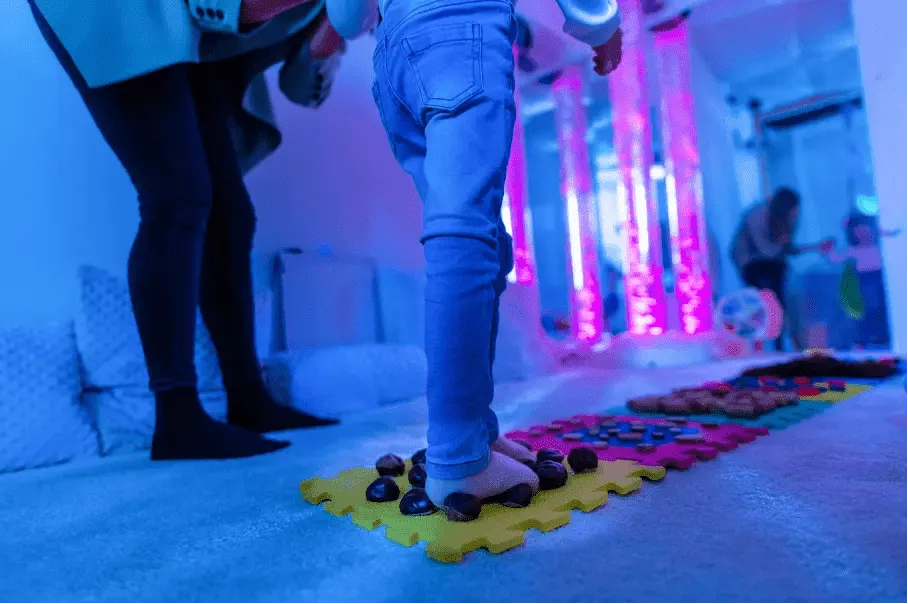
Sensory Integration in the Snoezelen Room
A sensory room, also known as a ‘Snoezelen sensory room’ or simply a ‘Snoezelen room’, is a specially designed space intended to create an environment that stimulates the senses whilst providing a sense of safety and relaxation. These rooms are often used when working with people with a range of needs, including those with developmental […]
Do you need some help?
Assessment of a young child’s development at the Dialog Centre for Children and Families
Early assessment of a child’s development (3 months – 3 years) — speech, motor skills, emotions and relationships. The sooner we identify any difficulties, the more effective the support will be.
Book a consultation