


Contents:
- The impact of dyscalculia on learning at school:
- How is dyscalculia diagnosed?
- Why is a diagnosis of dyscalculia so important?
- A report from a psychological and educational counselling centre – how do you obtain one, and what does it entitle you to?
- The process of obtaining an opinion
- What entitles a pupil to a diagnosis of dyscalculia?
- Supporting a child with dyscalculia – key steps
- Summary
- Bibliography
- Related articles
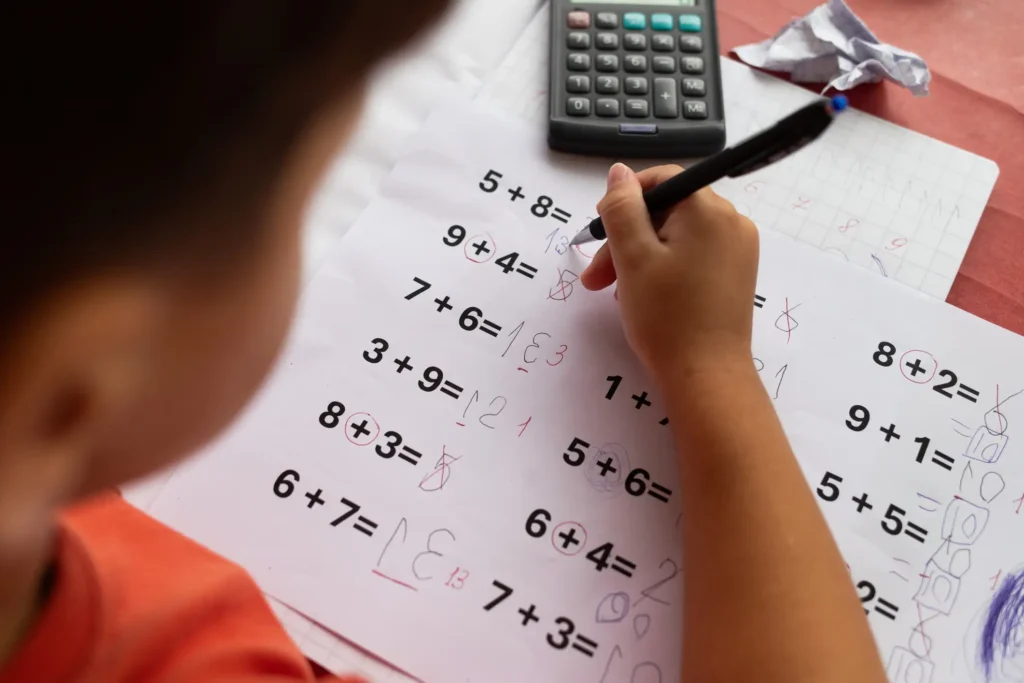
Dyscalculia is one of a number of specific developmental disorders, characterised by significant difficulties in learning mathematics. It is often referred to as ‘mathematical dyslexia’, because, just as with dyslexia (which affects reading and writing), dyscalculia mainly affects numeracy and the ability to work with numbers.
A child with dyscalculia has difficulty understanding numbers, performing even simple arithmetic operations, and recognising mathematical symbols (e.g. the ‘+’, ‘−’ and ‘÷’ signs, and fractions). These difficulties do not stem from a lack of intelligence or laziness – dyscalculia in no way indicates that a child has lower intellectual potential. It is a neurobiological disorder in which certain areas of the brain (responsible for processing numerical information) function differently.
Therefore, neither the child nor the teacher should be blamed for difficulties with maths – dyscalculia is not caused by a lack of effort or poor teaching, but by innate differences in brain function.
Do you need some help?
Dyscalculia assessment at the Dialog Centre
We diagnose specific learning difficulties in mathematics in children aged 10–16 — our formal assessment is recognised by schools and the Central Examination Board (CKE).
The impact of dyscalculia on learning at school:
A child with dyscalculia often struggles with arithmetic at every turn – addition, subtraction, multiplication and division present them with particular difficulties.
It may be the case that a pupil can recite the multiplication table from memory but is unable to apply this knowledge to practical problems. Difficulties also arise when comparing the sizes of numbers, reading multi-digit numbers (e.g. they may mix up the order of the digits), understanding concepts such as ‘greater than’ or ‘less than’, ‘half’ or ‘quarter’, and even in seemingly simple tasks such as telling the time on a clock or counting small change.
Dyscalculia mainly has a negative impact on performance in maths, but its effects can be more far-reaching – children with this disorder also sometimes struggle in other subjects that involve working with numbers or analysing relationships.
For example, pupils may find it difficult to understand scales on maps (geography), units of measurement in biology and chemistry, calculations in physics, or even in technical and historical subjects (e.g. the chronology of events). Sometimes, these problems even manifest themselves in PE lessons, when pupils need to time an exercise or count points in a game. Importantly, dyscalculia can be stigmatising – a child may experience frustration, shame and even a reluctance to go to school due to constant setbacks in maths.
That is why it is so important to understand the nature of this condition and to provide the pupil with the right support.
How is dyscalculia diagnosed?
The diagnosis of dyscalculia requires a professional assessment carried out by specialists at a psychological and educational counselling centre. You should not make such a diagnosis yourself – if you suspect that your child has dyscalculia, it is essential to consult a clinic, where appropriate diagnostic tests will be carried out.
In practice, diagnoses are carried out by psychologists and educationalists (and sometimes also neuropsychologists or speech and language therapists) who have experience of learning difficulties.
Assessing dyscalculia is a fairly complex process and usually takes place over several sessions. At the clinic, a specialist will first conduct a detailed developmental interview with the parent, asking about the child’s early development, their health, progress and difficulties at school (particularly with maths), as well as their interests and strengths.
The child then undergoes a series of psychological and educational assessments using standardised tools. Among other things, the level of cognitive function and intelligence is assessed to ensure that the difficulties do not stem from a general decline in mental ability.
The child’s mathematical skills (e.g. understanding numerical concepts, performing arithmetic operations, solving problems) and the strategies they use when counting are also examined in detail. The child’s working pace and the types of mistakes they make are also assessed, which helps to determine the extent and nature of their difficulties.
The diagnosis often also includes an assessment of visuospatial and auditory functions, working memory and other cognitive areas related to mathematics. It is also important to rule out other causes – the specialist will ensure that difficulties with arithmetic do not stem, for example, from a visual or hearing impairment or from other types of developmental disorders.
During the assessment, the centre usually asks for various materials relating to the child’s education to date – such as maths exercise books, class tests and short tests – as well as feedback from the maths teacher and form tutor. These materials help to identify exactly what the pupil is struggling with on a day-to-day basis and how they go about solving problems.
A full diagnosis of dyscalculia cannot be made in a single appointment – a broader assessment is required, and follow-up assessments are often necessary as well. In some cases, with younger children (Years 1–3 of primary school), specialists refrain from making a definitive diagnosis of dyscalculia, describing instead a risk of specific difficulties – this is because certain cognitive functions mature somewhat later, and a full diagnosis of dyscalculia is usually only made around Year 4 or later.
Nevertheless, early indicators (as early as in nursery or primary school) are very important – the sooner difficulties are identified, the sooner supportive measures can be put in place.
Once the assessment process has been completed, parents receive a written psychological and educational report confirming the presence of dyscalculia (provided the diagnosis is confirmed).
This report explains the reasons behind the child’s difficulties at school and provides detailed recommendations on how to support the child’s learning – both at school and at home. This report is an official document which can then be taken to the school so that appropriate support can be put in place for the child.
Do you need some help?
Dyscalculia assessment at the Dialog Centre
We diagnose specific learning difficulties in mathematics in children aged 10–16 — our formal assessment is recognised by schools and the Central Examination Board (CKE).
Why is a diagnosis of dyscalculia so important?
Early diagnosis of dyscalculia is crucial, as it enables the child to receive the right support quickly and prevents them from falling further behind.
If specific difficulties in learning maths are left untreated, they can lead to a range of consequences – a child who repeatedly fails may lose confidence, avoid lessons, develop a fear of school, or even become completely disheartened by education. A proper diagnosis prevents this from happening.
As specialists emphasise, the most important factor in ‘treating’ dyscalculia is precisely the early diagnosis of emerging difficulties. This enables remedial measures to be implemented swiftly, preventing incorrect habits from becoming ingrained and schoolwork falling further behind. In other words, diagnosis is the first and most important step, enabling the child and their carers to understand the nature of the problem and begin to deal with it.
What is more, formal confirmation of dyscalculia in the form of a specialist’s report protects the child from unfair assessment. With a diagnosis, teachers know that the pupil’s difficulties stem from a disorder rather than laziness or a lack of ability – this enables them to adapt educational requirements and assessment methods accordingly.
For a child, simply knowing that their problem has a name and a cause can be a relief: they realise that they are not ‘worse’ than their classmates, but simply need a different way of learning.
A diagnosis also paves the way for specialist support (e.g. remedial and compensatory classes, educational therapy), which enables the child to gradually overcome their difficulties. In summary, it is worth diagnosing dyscalculia as early as possible, because an accurate diagnosis is essential for effective support – the sooner we take action, the greater the chance that the child will catch up and gain confidence in their own abilities despite their difficulties with maths.
A report from a psychological and educational counselling centre – how do you obtain one, and what does it entitle you to?
A diagnosis of dyscalculia can be made by a public or private psychological and educational counselling centre. Public counselling centres (PPP) are free of charge, but the waiting time for a diagnosis can be long.
An alternative is private PPP counselling centres, which carry out assessments for a fee – however, it is essential that such a centre has official status granted by the local education authority. Only then do the opinions issued have legal force and are recognised by schools. One example is the ‘Dialog’ Centre for Children and Families in Warsaw – this centre has been granted the status of a non-public psychological and educational counselling centre and is listed in the official Register of Schools and Educational Institutions (RSPO No. 129211).
As a result, the assessments of dyscalculia issued by the Dialog Centre for Children and Families are official documents recognised by all nurseries and schools. In other words, parents no longer need to have the diagnosis confirmed at a public clinic – with such an assessment, they can go straight to their child’s school, and the school is obliged to accept it.
Do you need some help?
Dyscalculia assessment at the Dialog Centre
We diagnose specific learning difficulties in mathematics in children aged 10–16 — our formal assessment is recognised by schools and the Central Examination Board (CKE).
The process of obtaining an opinion
You should book your child in for an assessment (usually by telephone or online; appointments are often available at short notice). Before the assessment, parents complete an application form and provide the required documents, such as a report from the teacher and form tutor, as well as samples of the child’s work, as mentioned above. Specialists at the clinic then carry out the assessment for dyscalculia described above – often as part of a team (psychologist and educationalist) – in order to assess the pupil’s situation comprehensively.
Once the assessments have been completed, the parent receives a written report confirming that the child has specific difficulties in learning mathematics (dyscalculia). It is worth noting that such a report can be obtained at the earliest after the child has completed Year 3 of primary school, and no later than the end of primary school – this is in accordance with education regulations, which stipulate that specific learning difficulties can only be definitively confirmed after several years of schooling (although a risk of dyslexia or dyscalculia can be identified in earlier years).
Assessments carried out in Years 4–8 remain valid until the end of a pupil’s school education, so there is no need to repeat the assessment every year.
What entitles a pupil to a diagnosis of dyscalculia?
First and foremost, this involves adapting the educational requirements and assessment conditions to the pupil’s needs. Once the school has received the assessment report from the counselling centre, it (the teaching staff and the management) draws up an individual support plan for the pupil.
In practice, this means that teachers should implement the recommendations set out in the report – for example, in maths lessons, they should avoid calling pupils up to the blackboard in front of the class, ensure that more difficult concepts are explained in greater detail, and allow the child to use learning aids. During tests and exams, a pupil with dyscalculia is entitled to certain adjustments. These include, amongst others:
- Extra time on tests and exams, so that a slower pace does not prevent the child from demonstrating their knowledge. Usually, the extra time amounts to a dozen or so minutes (in the Year 8 exam or the A-levels, up to 30 minutes extra).
- The option to use a calculator or mathematical tables for calculation-based tasks. This allows the pupil to focus on understanding the task, rather than on tedious mental arithmetic, which they find difficult.
- Adapted assessment criteria for maths tasks – teachers should place greater emphasis on assessing the student’s line of reasoning and the correctness of the method used, whilst taking a less strict approach to minor calculation errors. In other words, if a child has understood how to solve a problem but has made a mistake in their calculations, the mark should take this into account.
Furthermore, as part of the psychological and educational support provided at school, a child with dyscalculia may receive individual remedial and compensatory lessons (educational therapy) in mathematics. Such sessions usually take place once a week at the school or a specialist centre and are led by a specialist.
Their aim is to practise with the child those areas that they find difficult – for example, improving their understanding of basic mathematical concepts, practising simple calculations, and developing the visual perception and working memory required for maths.
Importantly, an opinion from a psychological and educational counselling centre is also recognised by the regional examination boards – a pupil sitting key examinations (the Year 8 exam, the A-levels) on the basis of such an opinion is officially granted the adjustments described above (extended time, etc.). This enables them to sit the exam on an equal footing with their peers, despite their special needs.
Do you need some help?
Dyscalculia assessment at the Dialog Centre
We diagnose specific learning difficulties in mathematics in children aged 10–16 — our formal assessment is recognised by schools and the Central Examination Board (CKE).
Supporting a child with dyscalculia – key steps
As well as formal adjustments and legal provisions, the most important thing is the day-to-day emotional and educational support provided to a child with dyscalculia. Both parents and teachers should bear in mind that such a child requires an individualised approach and a great deal of patience.
You must not put undue pressure on them or punish them for failures – instead, you should praise even small steps of progress and encourage them to keep trying. The child must feel that they have support and that their worth is not measured by their maths marks.
It is also worth explaining to the class (their peers) what dyscalculia is – to prevent them from being teased or excluded, which could further lower the child’s self-esteem.
Teachers can adapt teaching materials to the pupil’s needs (e.g. set more practical tasks, use visual aids, charts and puzzles). Parents, for their part, should work together with the school and also help their child at home to consolidate their skills in a stress-free way.
Various games and activities that develop mathematical thinking are useful – for example, counting objects together, playing board games with dice (counting the dots), measuring ingredients whilst cooking, playing shop (giving change) or telling the time. Such everyday activities can help a child become familiar with numbers in a practical context.
Finally, it is worth noting a positive aspect: children with dyscalculia very often display talents in other areas, such as the arts, sport or languages.
Difficulties with maths by no means rule out their success at school – they may excel at reading, writing, music or art. It is the role of adults to help the child discover and develop these strengths, so that they can build their self-esteem despite their difficulties with maths.
With the right support, acceptance and understanding, a child with dyscalculia has the chance not only to catch up in maths to the best of their ability, but also to succeed in other areas and look to the future with optimism.
Do you need some help?
Dyscalculia assessment at the Dialog Centre
We diagnose specific learning difficulties in mathematics in children aged 10–16 — our formal assessment is recognised by schools and the Central Examination Board (CKE).
Summary
Dyscalculia is a serious learning disability, but one that can be diagnosed and supported. The earlier it is diagnosed, the better – a diagnosis paves the way for effective support for the child and for tailoring educational requirements to their needs.
Parents should not be afraid to seek specialist advice; this knowledge will enable them to work together with the school for the child’s benefit. With the right educational approach, therapies and supportive understanding from those around them, a pupil with dyscalculia can successfully develop their abilities and overcome difficulties at school, without losing their motivation or self-confidence.
Bibliography
- Bogdanowicz, M. (2011). Specific difficulties in learning mathematics – dyscalculia. Gdańsk: Harmonia Publishing House.
- Bogdanowicz, M., Adryjanek, A. (2004). Pupils with dyslexia at school. Warsaw: WSiP.
- Cieszyńska, J., Korendo, M. (2007). Early diagnosis and treatment of developmental disorders. Kraków: Wydawnictwo Edukacyjne.
- Grabowska, A., & Firkowska-Mankiewicz, A. (2011). Developmental Neuropsychology. Warsaw: PWN.
- Krasowicz-Kupis, G. (2008). Specific difficulties in reading and writing – dyslexia, dysgraphia, dysorthography. Warsaw: PWN.
- Rybakowski, J., Gałkowski, T. (eds.) (2009). Clinical Psychology of Children and Adolescents. Warsaw: PWN.
- Bogdanowicz, M. (2002). ‘Developmental dyscalculia – diagnosis and treatment.’ Educational Psychology, 45(6), 13–21.
- Szewczuk, W. (2004). ‘Difficulties in learning mathematics – a psycho-paedagogical approach.’ *Edukacja i Dialog*, no. 10.
- Stępień, J. (2015). ‘Diagnosis and support for pupils with dyscalculia.’ Problemy Opiekuńczo-Wychowawcze, no. 6, pp. 32–41.
- Ministry of Education and Science – Regulation of the Ministry of Education and Science of 9 August 2017 on psychological and educational support in state-funded nurseries, schools and other educational establishments.
- Central Examination Board – Information on adjustments to examination conditions for pupils with specific learning difficulties.
Psychological and Pedagogical Counselling Centre – ‘Dialog’ Centre for Children and Families, Warsaw: https://centrumdladzieci.pl
Do you need some help?
Dyscalculia assessment at the Dialog Centre
We diagnose specific learning difficulties in mathematics in children aged 10–16 — our formal assessment is recognised by schools and the Central Examination Board (CKE).
Book an appointmentRead more
Related articles
Dyslexia – what is it and what causes it?
Diagnosis: the most effective form of educational support for children and young people! Developmental dyslexia is a specific difficulty in learning to read and write that occurs in children with normal intellectual development. It is a neurodevelopmental disorder (with a neurobiological basis) – this means that it stems from abnormalities in the functioning of the […]
Support for pupils – why is a diagnosis of dyslexia important?
Not every instance of academic underachievement is down to laziness or a lack of ability on the part of the pupil. Sometimes, difficulties in mastering reading and writing skills are caused by specific learning difficulties. These are complex neurodevelopmental disorders which cause a child’s brain to process information differently – despite normal development, intelligence and […]
What is dysorthography? Symptoms, causes and treatment methods.
Not every typo is down to a lack of care, and not every spelling mistake is the result of rushing. Dysorthography affects thousands of children who know how to follow the rules of correct spelling but are unable to put that knowledge into practice. Why is that? What is dysorthography? What are its symptoms and […]

Speech and language therapy assessment – how does it work and when is it advisable to have one?
We often regard a child’s first words as one of the most important milestones in their development. Every little one goes through this stage at their own pace. However, it is worth keeping a regular eye on whether the subsequent stages in the development of our children’s communication skills are progressing as they should. To […]
Sensory Integration (SI) diagnosis – what is sensory integration and what does the assessment involve?
What is sensory integration? Sensory integration refers to the process by which the nervous system receives sensory stimuli and utilises them in everyday functioning. Thanks to this, the body is able to respond appropriately to sounds, sights, touch, movement, taste, smell and signals from the motor system. But what happens when certain aspects of this […]

Atypical autism – symptoms, diagnosis and prognosis
What is atypical autism? Atypical autism is a developmental disorder that falls within the broad spectrum of autism spectrum disorders. In practice, this means that a child with this type of autism may share many characteristics with people diagnosed with childhood autism or Asperger’s syndrome, however, their symptoms did not appear until after the age […]
Do you need some help?
ADHD diagnosis at the Dialog Centre
Book a consultation and we’ll help you choose a diagnostic pathway tailored to your child’s needs.
Book a consultation