


Contents:
- What is dyslexia? – difficulties with reading and writing
- Dysorthography – difficulties in mastering spelling rules
- Dysgraphia – difficulties with writing
- Dyscalculia – a barrier to learning maths
- When should you see a specialist?
- What is the purpose of a report from the school counselling service during school and in exams?
- Diagnosis at the Dialog Centre for Children and Families – fast and reliable
- Related articles
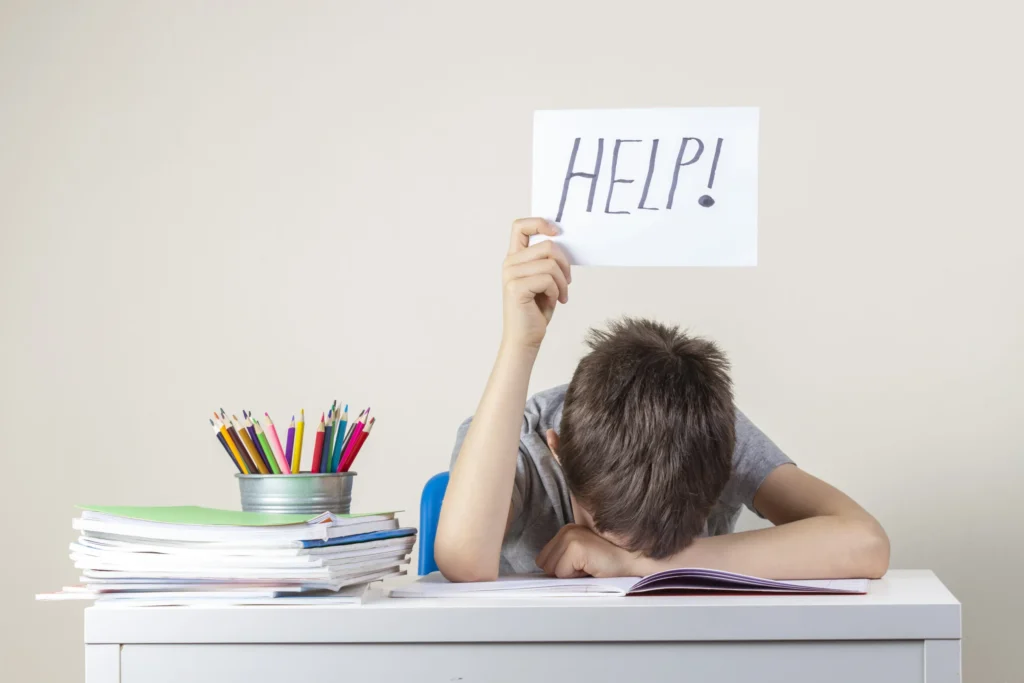
Not every instance of academic underachievement is down to laziness or a lack of ability on the part of the pupil. Sometimes, difficulties in mastering reading and writing skills are caused by specific learning difficulties. These are complex neurodevelopmental disorders which cause a child’s brain to process information differently – despite normal development, intelligence and a willingness to learn.
In practice, this means that the child has to work very hard to acquire academic skills and achieves poorer results despite their best efforts.
A professional assessment at a psychological and educational counselling centre enables the cause of the problems to be identified, and the pupil to be provided with appropriate support. This process culminates in the issuance of a report, on the basis of which the school can make adjustments to meet the child’s needs – both in day-to-day teaching and during examinations – thereby ensuring suitable educational conditions.
It also enables pupils to take part in remedial or compensatory lessons, which help them to overcome learning difficulties.
Do you need some help?
Assessment for dyslexia and dysorthography at the Dialog Centre for Children and Families
Is your child struggling with reading and writing? A diagnosis will explain the causes and pave the way for adjustments to be made to their schoolwork.
What is dyslexia? – difficulties with reading and writing
Developmental dyslexia is a disorder affecting the acquisition of reading and writing skills in children with normal intellectual development. A child with dyslexia reads slowly, mixes up letters, loses their place in lines, and has difficulty understanding text. It is common for them to transpose or omit letters, have difficulty distinguishing between sounds, and struggle to remember spelling rules. These difficulties may also stem from limited auditory perception. It is worth remembering that dyslexia is not linked to a lack of intelligence – it is simply a different way of learning, which, without support, can affect academic performance.
Dysorthography – difficulties in mastering spelling rules
Dysorthography is characterised by persistent spelling mistakes despite knowledge of the rules. The pupil mixes up letters, omits diacritical marks and spells words phonetically. Despite practising, they continue to make mistakes, which can be a source of frustration. An educational assessment often reveals that dyslexia co-occurs with other conditions, although it can occur on its own – the child reads correctly but is unable to write without making mistakes.
Dysgraphia – difficulties with writing
Dysgraphia relates to the graphic aspects of handwriting. The child writes slowly and illegibly; the letters are uneven and vary in size. This is often caused by poor fine motor skills and impaired eye-hand coordination. The pupil struggles to form letters correctly, stay within the lines or apply the correct pressure with the pen. Illegible notes make learning and marking work more difficult.
Dyscalculia – a barrier to learning maths
Dyscalculia is a specific learning difficulty, but it relates to mathematical ability. The child has problems with counting, understanding numerical concepts and arithmetic operations, and finds it difficult to tell the time, handle money or read maps. These difficulties arise despite the child having normal intellectual ability and motivation.
Unfortunately, neurodevelopmental difficulties are often mistakenly equated with a ‘lack of aptitude for maths’. However, an accurate diagnosis makes it possible to distinguish between these conditions and implement appropriate exercises.
Do you need some help?
Assessment for dyslexia and dysorthography at the Dialog Centre for Children and Families
Is your child struggling with reading and writing? A diagnosis will explain the causes and pave the way for adjustments to be made to their schoolwork.
When should you see a specialist?
The diagnosis of developmental dyslexia can involve multiple factors, and the diagnostic process may cover various areas. The first symptoms may appear as early as pre-school age – for example, a reluctance to draw, difficulties with rhyming or delayed speech development despite the child’s otherwise normal development.
In Years 1–3, teachers often spot signs of dyslexia when a child fails to master reading and writing despite their efforts. In such situations, it is best not to delay – a specialist centre can confirm whether there are any difficulties and issue an assessment regarding the risk of dyslexia, enabling early support to be provided.
It is recommended that the final diagnosis be carried out around Year 4 of primary school.
This is when difficulties with reading, writing or maths can be diagnosed most effectively. School-age children aged 10 and over can be successfully assessed for cognitive functions, which underlie many neurodevelopmental disorders. This is the diagnostic age at which it can be determined whether the absence of a particular skill is due to a cognitive deficit or a congenital condition.
An educational therapist at school may recommend that a pupil attends additional sessions, for example, to develop auditory memory. Implement the recommendations for remedial and compensatory classes, as well as exercises in correct spelling. The support of parents and teachers is extremely important for a child with specific learning difficulties.
If, despite receiving support, the symptoms of dyslexia persist and the difficulties in acquiring academic skills do not subside, specialists can definitively diagnose dyslexia.
It is worth considering having your child assessed if a teacher or educationalist recommends an assessment, if your child is significantly behind their peers, or if they are not making progress despite their best efforts. The sooner the problem is identified and educational therapy is put in place, the greater the chance of catching up.
It is worth consulting a specialist if a pupil aged 10–16:
- reads very slowly or with difficulty, loses their place in the text, skips lines, has difficulty understanding what they have read,
- makes numerous spelling mistakes despite knowing the rules (e.g. u/ó, ż/rz, ch/h), has difficulty remembering spelling rules,
- their handwriting is illegible and very slow – it is uneven and difficult to read; the child avoids writing things down or finds it very tiring,
- has serious difficulties with maths – he gets operations mixed up, gets confused by multi-digit calculations, and struggles with the multiplication table, fractions and reading graphs,
- has difficulty organising their work and remembering instructions – they misplace their homework, need instructions to be repeated several times, and get discouraged easily,
- avoids studying and reacts with severe stress to tests – complains that ‘it’s stupid’ or ‘she won’t manage it anyway’, has low self-esteem and a lack of self-confidence,
- despite regular practice, progress is minimal – even intensive work with a teacher or parent does not yield the expected results,
- There is a family history of similar difficulties – if a parent or sibling has been diagnosed with dyslexia, dysgraphia or dyscalculia, the child is at greater risk.
The sooner we identify the problem and begin educational therapy, the greater the chance that the child will catch up or learn to compensate for their difficulties.
Early diagnosis (even at the ‘at-risk’ stage) allows time for preventive measures to be taken and helps protect the child from developing bad habits or falling further behind at school.
Do you need some help?
Assessment for dyslexia and dysorthography at the Dialog Centre for Children and Families
Is your child struggling with reading and writing? A diagnosis will explain the causes and pave the way for adjustments to be made to their schoolwork.
What is the purpose of a report from the school counselling service during school and in exams?
A formal diagnosis, supported by a report from the psychological and educational counselling centre, forms the basis for providing the pupil with support. The school is obliged to ensure appropriate learning conditions for the pupil, tailoring teaching and assessment methods to their individual needs.
In external examinations (the Year 8 exam, the A-levels), this assessment enables the duration and format of the examination to be adapted to the pupil’s needs. This document is valid indefinitely, and its provisions are also recognised by higher education institutions.
The consequences of a lack of diagnosis and support
A failure to make a proper diagnosis at primary school stage can lead to mounting problems. A child who, despite their best efforts, fails to succeed loses self-confidence, avoids school, feels stressed and, over time, may develop defensive behaviours such as withdrawal or rebellion.
Unmet educational needs lead to low self-esteem and worsening emotional difficulties. Early diagnosis and treatment can prevent such consequences.
Diagnosis at the Dialog Centre for Children and Families – fast and reliable
Parents are often concerned about long waiting times at public clinics. The solution is to use an accredited private facility. The Dialog Centre for Children and Families operates in accordance with the requirements of the Ministry of Education, and the reports we issue are recognised by all schools. The process runs smoothly – it takes just a few weeks from the initial consultation to the issuance of the report.
What does a child’s diagnosis look like?
Our team of psychologists and educationalists provides a comprehensive assessment of difficulties relating to school performance, as well as therapeutic support, so that the child can develop to their full potential.
The whole process begins with an interview with the parents. During the assessment, the specialist analyses the pupil’s functioning, examines their visual and auditory perception, reading skills and knowledge of spelling rules, and analyses their academic performance, in order to provide the child with appropriate support and determine the options for therapy. The final stage involves recommendations regarding how to work with the pupil and address their needs.
To sum up
If your child is struggling despite their best efforts, it is worth considering a diagnosis to identify the cause. A professional assessment will help you understand the issues and pave the way for effective support.
Thanks to the help of specialists, many children regain their motivation and self-confidence.
The Dialog Centre for Children and Families is a place where every child can receive professional care and learn with joy, whilst feeling a sense of self-worth.
Do you need some help?
Assessment for dyslexia and dysorthography at the Dialog Centre for Children and Families
Is your child struggling with reading and writing? A diagnosis will explain the causes and pave the way for adjustments to be made to their schoolwork.
Sources: Research and recommendations concerning the diagnosis of specific learning difficulties are based on current psychological and educational studies and on education legislation.
This article draws on data and definitions taken from, amongst other sources, publications by specialist counselling centres and the Polish Dyslexia Association, as well as the Centre for Children and Families ‘Dialog’ team’s own experience in diagnostic work with children.
All the information cited confirms that an early and accurate diagnosis, combined with appropriate educational adjustments, is the key to success for a child with dyslexia, dysgraphia, dysorthography or dyscalculia.
With the right support, even serious difficulties can be overcome, and young people will have the chance to spread their wings to the full extent of their potential.
Bibliography:
- Bogdanowicz, M. (2011). The Risk of Dyslexia: The Problem and Diagnosis. Gdańsk: Harmonia Universalis Publishers.
- Bogdanowicz, M. (2012). Developmental dyslexia – a guide for parents and teachers. Gdańsk: Harmonia Universalis Publishers.
- Krasowicz-Kupis, G. (2008). The Psychology of Dyslexia. Warsaw: PWN Scientific Publishers.
- Krasowicz-Kupis, G. (ed.) (2013). Diagnosis of dyslexia in children and young people. Theory – practice – research. Warsaw: PWN Scientific Publishers.
- Grabowska, A., Bogdanowicz, K., & Krasowicz-Kupis, G. (2018). Specific learning difficulties – facts, myths, challenges. Warsaw: PWN Scientific Publishers.
- Ministry of Education and Science (2023). Regulation on the rules for the provision and organisation of psychological and educational support in state-funded nurseries, schools and other educational establishments. Journal of Laws of 2023, item 1795.
- Central Examination Board (2024). Notice on adjustments to the conditions and formats of examinations for pupils with specific learning difficulties. Warsaw: CKE.
- Polish Dyslexia Association (2022). Guidelines on the diagnosis and support of pupils with specific learning difficulties. Gdańsk: PTD.
- Bogdanowicz, M., Adryjanek, A. (2014). Pupils with dyslexia at school. A guide for teachers and parents. Gdańsk: Harmonia Universalis.
- Hellwig-Brzozowska, E. (2017). Developmental dyscalculia – identifying and supporting pupils. Warsaw: PWN Scientific Publishers.
- World Federation of Neurology (2020). Definition and Classification of Learning Disorders.
Read more
Related articles
Dyslexia – what is it and what causes it?
Diagnosis: the most effective form of educational support for children and young people! Developmental dyslexia is a specific difficulty in learning to read and write that occurs in children with normal intellectual development. It is a neurodevelopmental disorder (with a neurobiological basis) – this means that it stems from abnormalities in the functioning of the […]
Dyscalculia in children – what is it and how does it affect a child’s learning?
Dyscalculia is one of a number of specific developmental disorders, characterised by significant difficulties in learning mathematics. It is often referred to as ‘mathematical dyslexia’, because, just as with dyslexia (which affects reading and writing), dyscalculia mainly affects numeracy and the ability to work with numbers. A child with dyscalculia has difficulty understanding numbers, performing […]
What is dysorthography? Symptoms, causes and treatment methods.
Not every typo is down to a lack of care, and not every spelling mistake is the result of rushing. Dysorthography affects thousands of children who know how to follow the rules of correct spelling but are unable to put that knowledge into practice. Why is that? What is dysorthography? What are its symptoms and […]

Speech and language therapy assessment – how does it work and when is it advisable to have one?
We often regard a child’s first words as one of the most important milestones in their development. Every little one goes through this stage at their own pace. However, it is worth keeping a regular eye on whether the subsequent stages in the development of our children’s communication skills are progressing as they should. To […]
Sensory Integration (SI) diagnosis – what is sensory integration and what does the assessment involve?
What is sensory integration? Sensory integration refers to the process by which the nervous system receives sensory stimuli and utilises them in everyday functioning. Thanks to this, the body is able to respond appropriately to sounds, sights, touch, movement, taste, smell and signals from the motor system. But what happens when certain aspects of this […]

Atypical autism – symptoms, diagnosis and prognosis
What is atypical autism? Atypical autism is a developmental disorder that falls within the broad spectrum of autism spectrum disorders. In practice, this means that a child with this type of autism may share many characteristics with people diagnosed with childhood autism or Asperger’s syndrome, however, their symptoms did not appear until after the age […]
Do you need some help?
Assessment for dyslexia and dysorthography at the Dialog Centre for Children and Families
Is your child struggling with reading and writing? A diagnosis will explain the causes and pave the way for adjustments to be made to their schoolwork.
Book an appointment