


Contents:
- What is dysorthography?
- Dysorthography versus dyslexia and dysgraphia – what are the differences?
- What causes dysorthography?
- What are the symptoms of dysorthography?
- Specific learning difficulties in the early stages of schooling
- How can learning difficulties in the form of dysorthography be diagnosed?
- Diagnosis of dysorthography at the Dialog Centre for Children and Families
- Therapy or treatment for dysorthography – is there a difference?
- Why do learning difficulties require an individual education plan?
- What is an assessment report from the Psychological and Educational Counselling Centre, and how can I obtain one?
- Related articles
Not every typo is down to a lack of care, and not every spelling mistake is the result of rushing. Dysorthography affects thousands of children who know how to follow the rules of correct spelling but are unable to put that knowledge into practice. Why is that?
What is dysorthography? What are its symptoms and what causes it? How can we work with a pupil who has this disorder?
What is dysorthography?
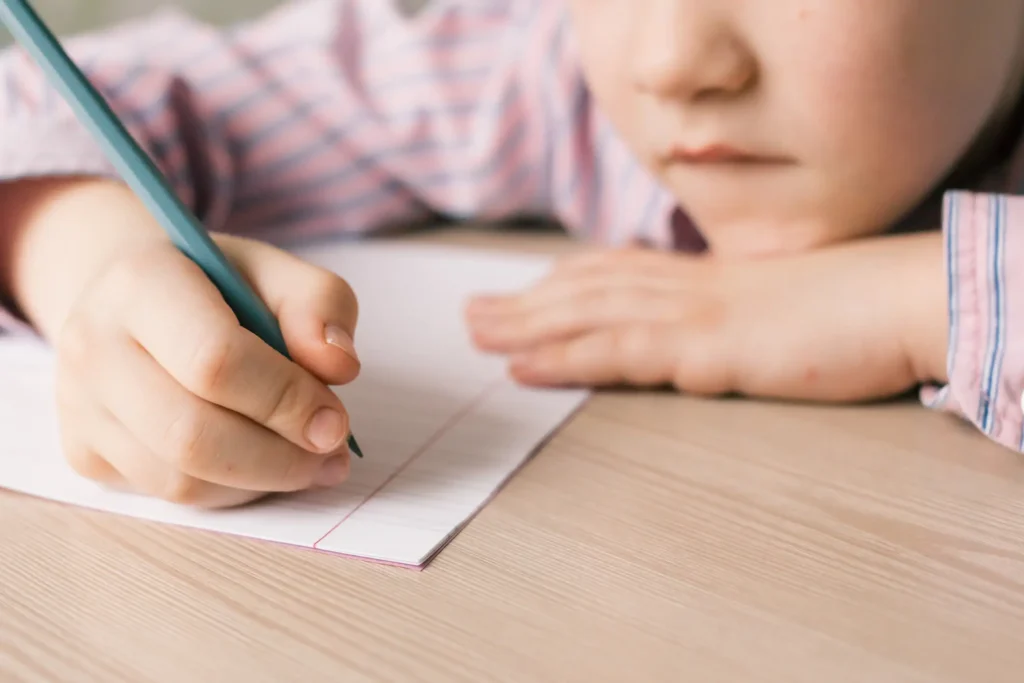
Dysorthography is a specific disorder characterised by difficulties with writing in terms of linguistic accuracy. A person with dysorthography has a good grasp of the rules of spelling, is able to remember them and explain them accurately, but does not apply them correctly when writing.
The causes of these difficulties lie in impairments in the processing of linguistic information. The brain of a person with dysorthography perceives speech sounds in a way that is not fully synchronised with their written form – a letter does not always ‘match’ the corresponding sound, and the written form of a word does not become firmly established in the memory. When writing, the phonetic reflex dominates – the child writes the word as they hear it, rather than as it should appear according to the rules of correct spelling.
Dysorthography is a disorder linked to the way the brain analyses and organises linguistic information. The problem does not stem from a lack of effort in learning. Writing does not become an automatic process due to the malfunctioning of the cognitive processes responsible for language encoding.
What may come as a surprise (and is sometimes even baffling) to some parents, carers and teachers, when children with dysorthography focus solely on the grammar rules they have memorised, they may complete a dictation correctly, but when writing a text on their own without giving it much thought, they will make mistakes.
The most common mistakes include:
- substitution of the letters ‘u/ó’, ‘rz/ż’, ‘h/ch’,
- omitting or adding letters,
- confusing the endings of words,
- phonetic spelling of words (as they are pronounced),
- no hyphenation or separate spelling of words,
- punctuation errors,
- problems with following the rules on capitalisation,
- difficulty distinguishing between words containing voiced and unvoiced sounds (e.g. ‘b’ and ‘p’, ‘d’ and ‘t’, ‘g’ and ‘k’).
Do you need some help?
Assessment for dyslexia and dysorthography at the Dialog Centre for Children and Families
Is your child struggling with reading and writing? A diagnosis will explain the causes and pave the way for adjustments to be made to their schoolwork.
Dysorthography versus dyslexia and dysgraphia – what are the differences?
Dysorthography is a disorder that very often occurs alongside dyslexia and dysgraphia. Together, they form part of the group known as specific learning difficulties (SLD). However, it is important to distinguish between them, as they all relate to different issues – issues that arise at different stages of language processing and vary in terms of their causes, symptoms and scope.
Dyslexia affects the way the brain recognises and analyses words. The child is able to think logically and is developing normally, but learning to read and write proves extremely difficult for them.
- They hear words differently from how they see them, and the written letters do not always produce the sound the child is familiar with.
- When reading, they confuse letters that sound or look similar (e.g. ‘b’ and ‘p’, ‘d’ and ‘t’, ‘m’ and ‘n’).
- Sometimes he rearranges the order of the syllables (‘kot’ – ‘tok’) or omits part of them.
- He reads slowly, often going back to the start of a sentence to understand its meaning.
- In longer texts, he loses the thread and his concentration, because he focuses all his effort on deciphering individual words.
Dysorthography relates to spelling errors, whereas in dyslexia, difficulties also include recognising, combining and understanding words. In young patients with dyslexia, visual or auditory processing difficulties, or problems relating to both sight and hearing, may be predominant.
Dysgraphia relates to the way a person writes. A child’s handwriting is illegible; the letters vary in shape and size, and the lines of text do not stay within the margins. Each sentence may look different – sometimes the words are too large, other times too small; some words ‘creep’ upwards, others downwards. The cause of writing difficulties lies in problems with fine motor skills (the movement of the hands and fingers).
Dysgraphia is not related to making spelling mistakes – the text may be grammatically correct, but the handwriting is distorted and difficult to read.
What causes dysorthography?
In our day-to-day lives, we rarely stop to think about how much effort our bodies put into performing seemingly simple tasks. Writing is one such activity. Before we can transform our thoughts into writing, every word must first be heard, recognised, remembered and converted into a written form. In a properly functioning nervous system, all these stages take place in a fraction of a second and in a strictly defined sequence. In a child with dysorthography, the entire process unfolds differently due to a distinct way of processing linguistic stimuli.
Most often, difficulties arise at the level of the connections between the auditory and visual processing centres and the areas of the brain responsible for working memory. It sounds rather complicated. However, it can be explained quite simply:
The sound of a word is not permanently linked to its written form, which means that the sound of a letter has no ‘image’ of its own. The brain therefore processes the information correctly, but does not interpret it in a way that complies with the rules of the language.
Neuroimaging studies carried out on people with dysorthography have shown reduced activity in the left hemisphere of the brain (in the temporal and parietal lobes). These are the areas responsible for phonological analysis, speech processing and the creation of a graphic representation of words.
It has been suggested that, in some patients, these disorders may be caused by microdysfunctions or microdamage to the central nervous system. This is how very subtle changes in the organisation of neural networks are described, changes which affect the efficiency of processing linguistic stimuli.
What are the symptoms of dysorthography?
Dysorthography manifests itself in the way a child writes, thinks about language, and in the emotions that accompany working with text. Leaving aside the issue of correct writing (we have given examples of typical errors above), it is important for parents and carers to be aware of the behaviours that may be associated with a child with this disorder. Mindfulness on the part of those closest to the child offers the opportunity to seek specialist help and begin the diagnostic process sooner.
What symptoms can help in diagnosing dysorthography?
- A sense of uncertainty is characteristic. The pupil is unaware of their mistake – even though they can memorise the spelling rules without much difficulty, they do not realise that they have failed to apply them. Attempts to correct the mistake lead to even greater confusion – the correction often introduces another error.
- A child with dysorthography often starts writing with a great deal of tension. They focus on every character they write, take longer than their peers and stop halfway through their work. They check the words they have written and then correct them (without being sure whether the change is correct). Different versions of the same words appear in their exercise book. In one line, the spelling may be correct; in the next, it may be wrong.
- Whenever the child is doing written work, one can observe signs of anger, tension or resignation emerging. The pupil opts for oral tasks and seeks reassurance from the teacher that ‘this is right’. They react to being told about their mistakes with surprise or a sense of injustice.
- Over time, a loss of linguistic fluency becomes apparent. The young patient develops their academic skills at an inadequate pace, simplifies their speech and writes short sentences, limiting the number of words used to avoid making mistakes. Their writing becomes devoid of linguistic fluency.
Do you need some help?
Assessment for dyslexia and dysorthography at the Dialog Centre for Children and Families
Is your child struggling with reading and writing? A diagnosis will explain the causes and pave the way for adjustments to be made to their schoolwork.
Specific learning difficulties in the early stages of schooling
The first signs of dysorthography become apparent in childhood, and it is usually the teacher who first notices them. It is the teacher who observes the child whilst they are learning, sees the pace at which they work, how they react to mistakes, and how they behave in situations requiring concentration. In the early years of schooling, the teacher is best placed to recognise that a pupil’s difficulties go beyond the typical slip-ups characteristic of the stage of learning to write.
The teacher’s role is to inform parents of their observations. However, it is the parents who can help their child by taking further steps to identify the causes of the problems reported.
Downplaying a teacher’s concerns can lead to a loss of precious time – the period during which appropriate intervention will yield the best results. The sooner a child is referred for an educational and psychological assessment, the greater the chance of halting the progression of their difficulties.
The scale of the problem is significant. It is estimated that various forms of SLD – including dysorthography – affect as many as several per cent of school-age children.
How can learning difficulties in the form of dysorthography be diagnosed?
Dysorthography is part of the specific learning difficulties (SLD) group. The DSM-5 (Diagnostic and Statistical Manual of Mental Disorders, 5th edition) and the ICD-11 (International Classification of Diseases) classify it as a disorder associated with the acquisition of writing skills.
The DSM-5 and ICD-11 describe the same type of difficulty, but in slightly different ways. The DSM-5 criteria focus on the child’s functioning and the impact of the disorder on daily life, whilst the ICD-11 is used for the formal coding of diagnoses in medical records and psychological and educational reports. Specialists most often use both classifications simultaneously – the DSM-5 helps to understand the nature of the difficulties more accurately (which may vary from patient to patient), whilst the ICD-11 allows for their official confirmation.
The diagnostic criteria for dysorthographia set out in the DSM-5 describe the occurrence of spelling errors, incorrect sentence structure, difficulties with punctuation and text organisation.
During the diagnostic process, specialists pay attention to:
- reading and/or writing skills that are significantly below what would be expected for their age and level of education,
- the difficulties persist for at least 6 months despite appropriate teaching,
- a significant impact on academic performance or day-to-day functioning,
- ruling out other causes (e.g. intellectual developmental disorders, neurological conditions, educational neglect).
In the ICD-11, the condition corresponding to dysorthography is included in the group ‘Developmental learning disorder with impairment in written expression’ (6A03.1). It describes a developmental disorder of writing skills, characterised by persistent spelling errors, difficulties with the structure of written expression and limited fluency in writing.
Diagnosis of dysorthography at the Dialog Centre for Children and Families
At the Centre for Children and Families ‘Dialog’, the assessment process is designed to gain a thorough understanding of how a child learns, remembers and records linguistic information. The assessment is intended for pupils aged 10 and over – this is the age at which difficulties with writing become clearly noticeable and established (this age limit provides greater assurance that the diagnostic assessment will reflect the young patient’s actual situation as accurately as possible).
The whole process involves two or three diagnostic sessions. Each one has a different purpose – first, the specialist talks to the parents, then observes the child whilst they carry out language tasks and analyses their writing. During the assessment, our specialists administer standardised tests to the young patient and evaluate the cognitive functions responsible for memory, concentration and the processing of visual and auditory information.
For the diagnosis to be accurate, the specialist needs to understand the child’s full developmental history. Parents are therefore asked to bring all relevant documentation to the first appointment – reports from other specialists, the school form tutor (or another teacher), school reports and a few recent exercise books. Furthermore, before the assessment begins, parents complete a questionnaire sent by email, in which they answer all the necessary questions. This ensures that our specialists already have a clear picture of the situation by the time of the consultation and can focus on the details.
In cases where the child has not previously undergone an intelligence test, we recommend administering the SB5 (Stanford-Binet V) test, which helps to rule out general developmental disorders. A specialist may also request an assessment of cognitive functions to determine which areas require greater support.
Once the assessment has been completed, the educationalist overseeing the entire process draws up a diagnostic report and an individual treatment plan. The document contains guidance for teachers and parents, including:
- information on the areas in which treatment should begin;
- a recommendation to extend working hours for tasks that involve writing;
- information on the individual assessment method.
At the Dialog Centre for Children and Families, we strive to understand the difficulties our patients face. Our specialists focus on the child’s strengths and on helping them realise their potential in learning. Each pupil is treated as an individual – taking into account their learning style, emotions and needs.
Do you need some help?
Assessment for dyslexia and dysorthography at the Dialog Centre for Children and Families
Is your child struggling with reading and writing? A diagnosis will explain the causes and pave the way for adjustments to be made to their schoolwork.
Therapy or treatment for dysorthography – is there a difference?
Dysorthography is a type of disorder – not a disease. It is usually long-term and rarely resolves without specialist support. However, the fact that difficulties have been identified does not necessarily mean that treatment should be started (treatment is not synonymous with therapy).
However, the importance of systematic work with a therapist is clearly emphasised – training in memory and linguistic awareness is regarded as a highly effective tool for reducing the number of errors and improving writing fluency.
Dysorthography cannot be ‘cured’, but it is certainly possible to work on the difficulties associated with it. How?
What does therapy for dysorthography involve?
At the Dialog Centre for Children and Families, we focus on taking an individualised approach to each pupil’s issues. Every therapy process begins with the creation of a plan. The course of treatment may form part of a diagnosis carried out earlier, or it may be the next step following a consultation where a formal assessment has already been issued.
Our specialists always focus on talking to parents and carefully reviewing the documentation provided. On this basis, we are able to recommend the best (from among the many) available treatment methods.
At the Dialog Centre for Children and Families, we run:
- individual educational therapy,
- cognitive training (visual or auditory perception training),
- remedial classes,
- reading and writing practice using the structural method,
- psychological support.
Sessions last 45 minutes. During the session, the pupil completes short language tasks and memory exercises presented in a fun way. The materials combine practical elements with patient interaction. To this end, we use worksheets, educational computer programmes, spelling boards, games and many other tools that offer a genuine opportunity to personalise the approach to therapy.
Our teachers respond to tension as it arises, reinforce the positive emotions associated with achieving success, and teach strategies for coping with school-related stress. As a result, the child gains the confidence to tackle written tasks.
Why do learning difficulties require an individual education plan?
When a child learns in a way that is tailored to their needs, they are given the space to truly develop. Tasks tailored to their abilities are a way of helping young patients stop struggling with a sense of failure and begin to understand that learning is not about competition. At the Dialog Centre for Children and Families, we focus on the gradual development of skills in a way that best suits the child – step by step, without pressure or fear of making mistakes.
In the assessment report, which highlights the need for individualised education, we take into account, amongst other things:
- a description of the child’s pace of work,
- the best type of materials for him,
- an appropriate number of tasks to be carried out at any one time,
- acceptable methods of assessing knowledge.
The document informs teachers that a child may need more time to complete tests, that extensive material may need to be broken down into shorter topics, and that the child may be allowed to demonstrate their understanding of successive stages of learning through oral answers rather than written tests, or by using a computer instead of a notebook.
An individual education plan creates a predictable environment in which a pupil can develop their strengths whilst also working on the tasks that cause them the greatest difficulty.
What is an assessment report from the Psychological and Educational Counselling Centre, and how can I obtain one?
The report from the Psychological and Educational Counselling Centre officially confirms and sets out the child’s individual developmental, educational or health needs. It contains a detailed description of the child’s difficulties and strengths, as well as guidance on how to support the child at school and at home.
To obtain an assessment, a parent must submit an application to the Psychological and Pedagogical Counselling Centre – they may decide to initiate the procedure themselves or do so following a recommendation from the school. An essential part of obtaining an assessment is the diagnostic process. Based on its results, the Centre can issue the relevant document.
At the Dialog Centre for Children and Families, we are able to provide comprehensive care and carry out all the necessary consultations and tests.
Official documents recognised by schools and state institutions are issued by public Psychological and Pedagogical Counselling Centres and non-public Psychological and Pedagogical Counselling Centres authorised to do so. All schools and educational establishments operating in accordance with education law are listed in the Register of Schools and Educational Establishments (RESPO).
Do you need some help?
Assessment for dyslexia and dysorthography at the Dialog Centre for Children and Families
Is your child struggling with reading and writing? A diagnosis will explain the causes and pave the way for adjustments to be made to their schoolwork.
Bibliography
- Kochańska, M., Zawadka, J., Beck, J., & Dzięgiel-Fivet, G. (2023). A university accessible to students with specific learning difficulties. A handbook for specialists, academic staff and higher education administrators. Warsaw: Centre for Teaching Support, University of Warsaw.
- Kajka, N. (2018). Difficulties in learning to read and write among children with ADHD. Special School, 3(294), 212–218.
- Łockiewicz, M. (2025). Symptoms of developmental dyslexia and tools for measuring them – a review of the current state of knowledge. Annales Universitatis Mariae Curie-Skłodowska, sectio J – Paedagogia-Psychologia, 38(1), 131–147.
- Jakóbik, S. P. (2019). Pupils with dysorthography in Polish language lessons. Łódź: ArchaeGraph Academic Publishing House.
- Costa, L. J. C., Spencer, S. V., & Hooper, S. R. (2022). Emerging neuroimaging findings on written expression in children: a scoping review. Brain Sciences, 12(3), 406.
- Turker, S., Kuhnke, P., Jiang, Z., & Hartwigsen, G. (2023). Disrupted network interactions serve as a neural marker of dyslexia. *Communications Biology*, 6(1), 1114.
- Chieffo, D. P. R., Arcangeli, V., Moriconi, F., Marfoli, A., Lino, F., Vannuccini, S., … & Mercuri, E. M. (2023). Specific learning disorders (SLD) and behavioural impairment: comorbidity or specific profile?. Children, 10(8), 1356.
- Hepner, C., McCloskey, M., & Rapp, B. (2019). Do reading and spelling share orthographic representations? Evidence from developmental dysgraphia. In Developmental Dysgraphia (pp. 55–79). Routledge.
- Sahoo, M. K., Biswas, H., & Padhy, S. K. (2015). Psychological co-morbidity in children with specific learning disorders. Journal of Family Medicine and Primary Care, 4(1), 21–25.
- Krasowicz-Kupis, G. (2025). Differential diagnosis of developmental dyslexia as a learning disability. Warsaw: Centre for Educational Development.
- Regulation of the Minister of National Education of 1 February 2013 on the detailed rules governing the operation of public psychological and pedagogical counselling centres, including public specialist counselling centres (Journal of Laws 2013, item 199). https://isap.sejm.gov.pl/isap.nsf/DocDetails.xsp?id=wdu20130000199.
Read more
Related articles

Autism spectrum assessment – a step-by-step guide to diagnosis
Autism is a complex issue, and the subject is attracting increasing interest amongst both parents and professionals working with children and adults. More and more children are being referred to specialist clinics on the suspicion that their development is different, with the child’s difficulties being particularly evident in social interactions, communication or behavioural patterns. This […]
What rules out Asperger’s syndrome – factors in the differential diagnosis
Asperger’s syndrome – an autism spectrum disorder Asperger’s syndrome is a neurodevelopmental disorder classified within the autism spectrum, characterised by a different pattern of social and communicative development. It is not a disease in the medical sense, but rather a different pattern of brain development. The term derives from the name of the Austrian paediatrician […]
Rett syndrome – what it is, symptoms and causes of this rare disorder
What is Rett syndrome? Rett syndrome is one of the most frequently described rare and specific neurodevelopmental disorders affecting girls. In the literature, it is also referred to as Rett or Rett syndrome and belongs to the group of serious genetic disorders. Typically, Rett syndrome occurs in children who initially develop normally, but later experience […]

Autism – symptoms. How can you recognise them in children and teenagers?
Autism is a neurodevelopmental disorder that affects the way a person perceives the world, interacts with others and processes information. Nowadays, we talk about the autism spectrum, as symptoms and the level of support required can vary greatly. There is still a lack of reliable information on this subject, which is why many myths hinder […]

Heller’s syndrome – symptoms, progression and diagnosis of a rare disorder
Heller’s syndrome, also known as childhood disintegrative disorder, is one of the rarest and most dramatic developmental disorders. It is characterised by the sudden loss of previously acquired skills in a child who had been developing normally during the first few years of life. Due to its rapid onset and profound regression in functioning, this […]
The ADHD spectrum – symptoms, types and support strategies
ADHD (attention-deficit/hyperactivity disorder) is increasingly described not as a homogeneous disorder, but as a spectrum of symptoms and ways of functioning. This means that people with ADHD can vary greatly from one another – both in terms of the difficulties they face and the resources they have. Understanding the ADHD spectrum helps us to recognise […]
Do you need some help?
Assessment of dyslexia and dysorthography at the Dialog Centre for Children and Families
Is your child struggling with reading and writing? A diagnosis will explain the causes and pave the way for adjustments to be made to their schoolwork.
Book an appointment