



Contents:
- What are sensory integration disorders?
- What are sensory processing disorders?
- What are the causes of sensory integration disorders?
- What are the different types of sensory disorders?
- What are the symptoms of sensory processing disorders?
- What does the diagnosis of sensory integration disorders in children involve?
- What is sensory integration therapy?
- FAQ – what are the most common questions asked by parents of young patients?
- Bibliography
- Related articles
Every day, a child’s brain receives hundreds of stimuli – sounds, images, smells, touch, sensations from movement and from within the body. If they can make sense of them, the little one learns and plays without any major difficulties.
However, when a child’s nervous system becomes ‘overwhelmed’ by this flood of signals, everyday activities can become a real challenge for them.
Are we talking about sensory integration disorders in this case? How can we support a child facing such difficulties? When and where should we seek help?
What are sensory integration disorders?
Sensory integration is the process by which the brain organises information received through sight, hearing, touch, smell, taste, proprioception (deep sensation), the vestibular system (balance) and interoception (sensations from the internal organs).
The concept of sensory integration disorder was introduced in the 1970s by A. Jean Ayres, an American occupational therapist and psychologist.
If each stage of this process proceeds correctly, the child is able to respond to stimuli in a manner appropriate to the situation – the receptors of the various sensory organs receive stimuli, and the young patient’s nervous system is able to organise the signals and combine them into a coherent picture.
However, if a child does not process and interpret stimuli correctly, they may perceive the world in a fragmented and chaotic way – and, as a result, fail to respond appropriately to what they see, hear and feel.
Do you need some help?
Sensory Integration Assessment at the Dialog Centre for Children and Families
We assess how a child processes sensory stimuli — and draw up a personalised support plan tailored to their sensory profile.
What are sensory processing disorders?
Sensory integration disorders versus sensory processing disorders – can these terms be treated as synonyms? Although both terms refer to similar behaviours, a closer look at their definitions reveals that they are not one and the same.
‘Sensory Processing Disorder’ (Sensory Processing Disorder, SPD) builds on Ayres’s concept but describes a broader range of issues. SPD refers to every stage of a stimulus’s journey through the nervous system – reception, modulation (regulation of intensity) and response.
It distinguishes between various types of disorders, which describe specific patterns of difficulties (the full spectrum of problems).
Sensory integration disorders and sensory processing disorders – are the two terms used interchangeably in practice?
How does this look from a parent’s perspective? Do we need to know the finer points of the definition? It’s certainly worth knowing, but in reality the precise distinctions are mainly important from the point of view of research and scientific terminology.
In conversations with parents and in therapists’ offices, the two terms are sometimes used interchangeably. In both cases, they refer to the same phenomenon – a child’s difficulties relating to sensory stimuli.
What are the causes of sensory integration disorders?
Difficulties with sensory integration do not have a single, simple cause. It is a complex issue linked to the development and functioning of the nervous system.
A child’s brain develops very rapidly during the first few years of life, forming millions of connections between neurons (nerve cells). During this period, the nature of the developmental process itself and the sensory stimuli the child is exposed to in their environment are of paramount importance.
The factors (a whole range of circumstances) that may increase the likelihood of difficulties arising in the development of sensory integration are described. Some of these are biological in nature and relate to the period of pregnancy and childbirth. Others concern the very processes taking place within the nervous system, whilst others still relate to the environmental conditions in which the child is brought up.
Although potential causes are mentioned, it is worth emphasising that, in many children, it is not possible to identify a single specific factor that unequivocally caused the problem to develop.
Factors that may contribute to the development of sensory integration disorders include:
- preterm birth and low birth weight,
- complications during pregnancy and childbirth (e.g. perinatal hypoxia),
- diseases and damage to the nervous system,
- genetic predisposition,
- co-occurring neurodevelopmental disorders – ASD, ADHD, developmental delays,
- exposure to toxic substances during pregnancy (including alcohol, smoking, exposure to heavy metals, exposure to drugs and certain medicines),
- the absence of a stable, secure bond with a carer.
What are the different types of sensory disorders?
In children with sensory integration disorders, difficulties do not manifest in the same way. They can affect different senses and vary in severity. Problems with processing sensory input often do not affect just one area – several (sometimes all) may overlap and create a unique set of difficulties that the young patient has to cope with.
For some children, the difficulties mainly relate to their responses to sounds and touch; for others, they are linked to movement or planning activities.
For this reason, in the case of sensory integration disorders, a classification is used to distinguish between different types of difficulties and their subtypes. This often makes it easier for parents to understand where the problem lies and how it might affect their child’s day-to-day functioning.
Based on the main symptoms of the disorder, a specialist can identify areas of the child’s behaviour where the child may need support – this is how the therapy is planned.
Sensory modulation disorders
This is a group characterised by difficulties in regulating the intensity of their responses to stimuli. Three subtypes can be distinguished within this group:
- sensory hypersensitivity – the child reacts too strongly;
- sensory under-responsiveness – signals reach the brain but do not elicit a sufficient response. The child seems to ‘overlook’ stimuli;
- sensory exploration – the child constantly seeks out intense sensations (jumping, spinning round, hugging tightly, banging on objects).
Sensory differentiation (sensory discrimination) disorders
The difficulty here lies in distinguishing between different stimuli. The child hears or sees, but is unable to identify precisely what the sound or shape is. They may have difficulty distinguishing between textures, gauging the strength of their grip, locating the source of a sound, or judging distance.
Motor disorders
In this case, abnormal integration of sensory input affects motor control. The following are observed in patients:
- dyspraxia – difficulty in planning and organising new motor activities. The child knows what they want to do, but is unable to plan the sequence of movements required to achieve their goal;
- postural problems – these relate to body stabilisation. A child may have reduced muscle tone, difficulty maintaining balance or sustaining effort during motor tasks.
Do you need some help?
Sensory Integration Assessment at the Dialog Centre for Children and Families
We assess how a child processes sensory stimuli — and draw up a personalised support plan tailored to their sensory profile.
What are the symptoms of sensory processing disorders?
Sensory difficulties can take many different forms. There is no single pattern of symptoms associated with sensory disorders in children.
Some patients will be overly sensitive to stimuli, others will ignore them, whilst others will constantly seek them out. It is also the case that difficulties arise only in certain situations – for example, in large crowds or during activities involving physical movement.
For this reason, it is important to take a holistic view of the child’s behaviour and to observe how they cope in everyday situations.
The first symptoms of SI disorders
The first signs may be subtle and easy to overlook (especially in a baby). These may include a reluctance to engage in certain activities, excessive agitation in certain situations, or unusual reactions to everyday activities.
Initially, the symptoms of sensory processing disorders are most often attributed to the young patient’s personality traits – the child is described, for example, as energetic or stubborn.
Every young child develops at their own pace and has the right to be different. Nevertheless, it is worth discussing any concerns carers may have with a specialist. An early consultation does not necessarily lead to a diagnosis, but it provides an opportunity to monitor the child’s development with full awareness and to offer prompt support should any genuine difficulties arise.
This ensures that parents are not left to cope with uncertainty on their own, whilst the patient is given the opportunity to better understand their own needs.
Sensory integration disorders – symptoms and examples of behaviours
The symptoms of sensory modulation disorder can be divided into those associated with hyper-responsiveness, hypo-responsiveness and stimulus-seeking.
Hyperreactivity:
- avoiding hugs (which may be perceived as emotional withdrawal),
- hypersensitivity to sounds, covering one’s ears during everyday household noises (e.g. vacuuming),
- a reluctance to wash one’s hair or brush one’s teeth,
- difficulty wearing clothes with labels or seams,
- anxiety whilst driving,
- difficulty falling asleep and sleep disorders.
Hyporeactivity:
- no reaction to minor cuts or bruises,
- indifference to very cold or very hot water,
- difficulty in noticing dirt on the body,
- no response to loud noises,
- slowness in carrying out everyday tasks and taking a long time to process information,
- little interest in their surroundings.
Seeking sensory stimulation:
- frequent spinning round one’s own axis,
- jumping on the furniture,
- hitting objects and people,
- a firm handshake,
- putting objects in one’s mouth,
- chewing on pencils and clothes,
- provoking rough-and-tumble play with peers,
- a preference for very intense stimuli (e.g. loud music, bright light).
In sensory differentiation disorders, symptoms can be classified according to the senses.
Touch:
- difficulty recognising objects without visual cues,
- confusing textures (e.g. smooth and rough),
- inability to distinguish shapes whilst keeping one’s eyes closed,
- uncertainty when handling small parts.
Vision:
- losing one’s place in the text whilst reading,
- difficulty in distinguishing between similar images,
- a lack of spatial awareness (e.g. in the classroom or on the playground).
Listening:
- difficulty in distinguishing between similar sounds (e.g. ‘p’ and ‘b’),
- difficulty understanding instructions in noisy surroundings,
- difficulty repeating a longer sequence of words or numbers,
- confusing sounds that sound similar.
Proprioception (deep sensation):
- difficulty in judging distance and force (pushing or squeezing too hard),
- a problem with assessing one’s position in space,
- difficulties with physical activities requiring fluid movement.
The vestibule (sense of balance):
- uncertainty when walking up and down the stairs without holding onto the handrail,
- a dislike of swings, roundabouts or slides,
- severe dizziness following a brief rotational movement,
- losing one’s balance whilst running,
- difficulties in learning to ride a bike or rollerblades.
In children with sensory processing disorders affecting motor skills, the symptoms most commonly involve:
- motor planning – difficulties in mastering new tasks (e.g. tying shoelaces, doing up buttons or stacking blocks);
- coordination – frequent falls, difficulties with team games (such as catching a ball or running in a group), lack of fluidity of movement, and problems with cycling, skateboarding or riding a scooter;
- fine motor skills – incorrect pencil grip, difficulty colouring within the lines, problems cutting with scissors, clumsy use of cutlery, frequently dropping objects;
- gross motor skills – motor disorders, difficulty maintaining rhythm whilst dancing, tiring quickly during exercise, lack of synchronisation in whole-body movements, stiffness when performing tasks that require smooth changes of position.
Do you need some help?
Sensory Integration Assessment at the Dialog Centre for Children and Families
We assess how a child processes sensory stimuli — and draw up a personalised support plan tailored to their sensory profile.
What does the diagnosis of sensory integration disorders in children involve?
At the Dialog Centre for Children and Families, the whole process is divided into several sessions. To begin with, the therapist talks to the parent, gathering information about the child’s development and day-to-day functioning. Subsequent visits involve observing the child in the sensory integration room and carrying out tests to assess how the young patient responds to sounds, movement, touch and visual stimuli.
All the procedures carried out are summarised at the final consultation. Our specialists discuss the results and explain in simple terms what might be causing any difficulties. Parents always receive a plan for further support.
We make sure that every parent has a clear understanding of the situation and specific guidance on how to help their child.
What is sensory integration therapy?
Sensory therapy is a form of activity designed to help a child learn to perceive and organise environmental stimuli correctly. The whole process is based on the child’s diagnosis and individual needs.
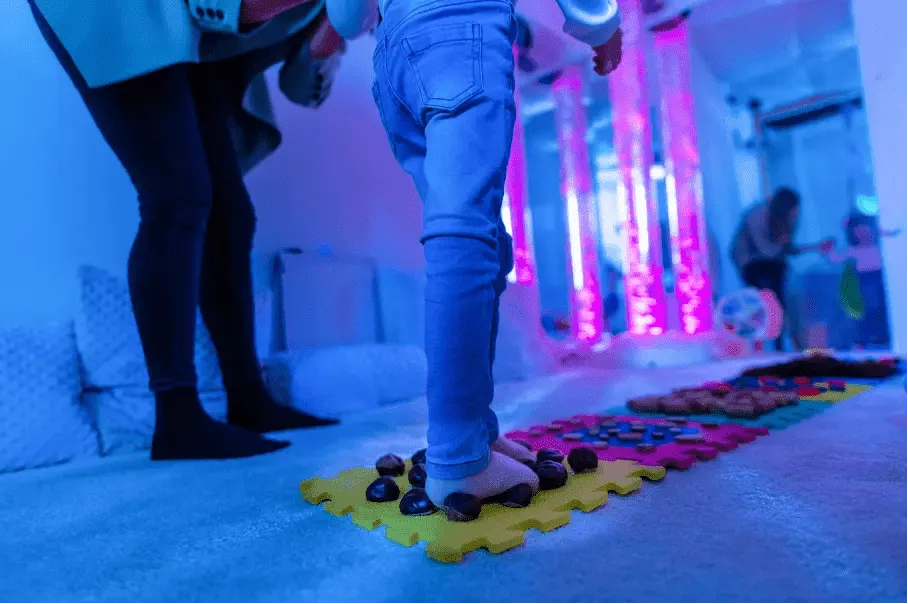
The most important thing is that the therapy is nothing like traditional lessons or desk-based exercises. It consists of activities in a room equipped with equipment that encourages movement and play – swings, climbing frames, balls, platforms and various textures to touch.
During the sessions, the child climbs, jumps, rolls, balances, crawls through tunnels or takes part in activities that require manual dexterity. The therapist selects activities so as to gradually practise with the young patient those areas which, during the diagnostic process, proved to be the greatest difficulty.
The process of sensory integration teaches the nervous system to ‘organise’ stimuli more effectively. Over time, the child becomes calmer in noisy environments, finds it easier to concentrate, and copes better with physical play and everyday activities that were previously a source of frustration in their life. It is a process that requires consistency and patience, but for many families it provides significant support in their daily lives.
Sensory integration courses for therapists, psychologists and psychiatrists are organised by the Polish Association of Sensory Integration Therapists.
At the Dialog Centre for Children and Families, therapy for children and adults is provided exclusively by specialists who hold the relevant qualifications.
FAQ – what are the most common questions asked by parents of young patients?
Is SI therapy effective?
Sensory integration (SI) therapy can improve the way a child perceives and processes sensory input. Working with a therapist is a very effective way of overcoming difficulties and developing new skills; however, the results depend on the regularity of the sessions, the patient’s age and the appropriate choice of sensory integration method.
The best results are seen when therapy combines exercises with daily support at home. At the Dialog Centre for Children and Families, we help whole families to manage the entire process effectively
Do patients with sensory integration disorders always exhibit all types of these disorders?
No. The disorders may affect a single area (e.g. the sense of sight) or involve all the sensory systems (e.g. hypersensitivity to sounds combined with difficulties in planning movements).
What types of sensory integration disorders are typical in patients with autism spectrum disorders?
In people on the autism spectrum, sensory integration disorders most commonly involve difficulties in modulating stimuli – hyper-reactivity, hypo-reactivity or a search for additional sensory stimulation. It should be noted that not every person on the spectrum experiences the same difficulties.
Can the symptoms of sensory integration disorders get worse?
Unfortunately, if a child does not receive the right support, the symptoms may worsen and affect other areas of their functioning. Early intervention reduces the risk of these difficulties becoming more severe.
Do sensory integration disorders in adults occur with the same frequency as sensory disorders in children?
Sensory integration disorders are most commonly described in children. However, they can also occur in adult patients. In such cases, they usually present differently – they often stem from earlier, unresolved difficulties or co-occur with other problems (e.g. anxiety disorders or ASD).
Do you need some help?
Sensory Integration Assessment at the Dialog Centre for Children and Families
We assess how a child processes sensory stimuli — and draw up a personalised support plan tailored to their sensory profile.
Bibliography
- Randell, E., Wright, M., Milosevic, S., Gillespie, D., Brookes-Howell, L., Busse-Morris, M., … & McNamara, R. (2022). Sensory integration therapy for children with autism and sensory processing difficulties: the SenITA RCT. Health Technology Assessment, 26(29).
- Andelin, L., Reynolds, S., & Schoen, S. (2021). Effectiveness of occupational therapy using a sensory integration approach: A multiple-baseline design study. The American Journal of Occupational Therapy, 75(6), 7506205030.
- Drzeżdzon, P. (2023). The importance of sensory integration therapy for children with neurodevelopmental disorders. Student with a Disability: Essays and Dissertations, 23(16), 45–60.
- Jurkiewicz, P. (2016). Sensory integration processes and learning. KSW Scientific Journal, 43(15), 69–77.
- Wiśniewska, M. (2022). Are you too old for sensory integration? The role of sensory integration in the treatment of adults with sensory processing disorders. Journal of Occupational Therapy, 48, 11.
- Polish Association of Sensory Integration Therapists. Training courses. Retrieved from: https://panel.pstis.pl/all/szkolenia
- Schmitt, C. M., & Schoen, S. (2022). Interoception: A multi-sensory foundation of participation in daily life. Frontiers in Neuroscience, 16, 875200.
- McArthur, A. L. H. (2022). The debate over sensory processing disorder. American Journal of Psychiatry Residents’ Journal, 17(4), 14–15.
- Clark, E., Brown, T., & Yu, M. L. (2025). Interoception and its application to paediatric occupational therapy: A scoping review. Australian Occupational Therapy Journal, 72(1), e12997.
- Greaves-Lord, K., Skuse, D., & Mandy, W. (2022). Innovations of the ICD-11 in the field of autism spectrum disorder: a psychological approach. Clinical Psychology in Europe, 4(Special Issue), e10005.
- Bielec, D. (2024). Sensory integration disorders in children and young people on the autism spectrum in the context of depressive disorders – a literature review. Scientific Journal of Special Education, (17), 94–116.
- Cahill, S. M., & Beisbier, S. (2020). Occupational therapy practice guidelines for children and young people aged 5–21 years. The American Journal of Occupational Therapy, 74(4), 7404397010p1–7404397010p48.
Read more
Related articles

Psychomotor development (children aged 0–3 years)
A child’s psychomotor development is a process in which the child develops both their mental and motor skills during the first three years of life. This is a period of rapid change, during which a child reaches many milestones in the development of their motor, cognitive and social skills. During the first three years of […]

Snoezelen, or the Sensory Room
1. Introduction The senses form the basis of every person’s development. They provide information about the world around us. Without them, none of us could develop. However, some people are unable to respond to them appropriately, whilst others have lost these abilities due to an accident or illness. For these people, the world can be […]

Sensory diet
Where does the term ‘sensory diet’ come from? The term ‘sensory diet’ was introduced by Patricia Wilbarger, an American occupational therapist and specialist in sensory integration. Wilbarger developed this concept in the 1990s as part of her work with children and adults who had difficulties with sensory processing. She was a pioneer in this field, […]

Sensory overload – symptoms, causes and ways of coping
Sensory overload is a condition in which the nervous system receives more stimuli than it is able to process effectively. It can affect anyone, but is particularly common amongst highly sensitive people, those with neurodiversity, and those living under chronic stress. It manifests itself both physically and mentally, affecting day-to-day functioning, relationships and well-being. In […]

Social skills training for children
Social Skills Training, abbreviated to TUS, can be described, in the simplest terms, as active therapy in the form of workshops, which are conducted in groups of people of a similar age or with a similar level of functioning. The aim of TUS is to develop emotional and social skills through modelling (i.e. learning by […]
Sensory Integration in the Snoezelen Room
A sensory room, also known as a ‘Snoezelen sensory room’ or simply a ‘Snoezelen room’, is a specially designed space intended to create an environment that stimulates the senses whilst providing a sense of safety and relaxation. These rooms are often used when working with people with a range of needs, including those with developmental […]
Do you need some help?
Sensory Integration Assessment at the Dialog Centre for Children and Families
We assess how a child processes sensory stimuli — and draw up a personalised support plan tailored to their sensory profile.
Book an SI assessment