


Contents:
- It is worth knowing in which areas the development of a child on the spectrum differs. ‘Taking on a challenge’ does not mean fighting.
- The first signs of autism – what should we look out for, and when should we be concerned?
- What are the signs of autism (autism spectrum disorders) in pre-school children?
- The various manifestations of autism spectrum disorders in infants and young children
- Autism spectrum disorders in teenagers
- FAQ – symptoms of autism in children – what do you need to know about autism spectrum disorders?
- Related articles
A child who ‘lives in a world of their own’ – this is a very unfair stereotype that has persisted for years in relation to young patients with autism spectrum disorders. Doesn’t this description actually apply to all of us? After all, we all have a different set of characteristics and experience everyday situations in different ways.
So why is it still so difficult to understand that the same applies to how a child with an autism spectrum disorder functions? Behaviours that are generally regarded as ‘different’ are simply the norm for many families. And that is how we should approach this – with a great deal of understanding, awareness and a willingness to adapt to reality.
It is worth knowing in which areas the development of a child on the spectrum differs. ‘Taking on a challenge’ does not mean fighting.
The first signs of autism – what should we look out for, and when should we be concerned?
The first few months of life with a baby are a time when parents watch their little one’s every gesture and reaction closely. Everything is new, different and unprecedented. We usually look forward to a smile, eye contact or a reaction to our voice. For some children, these moments occur later or look different from those of their peers.
A child’s development proceeds at their own pace. Paediatricians and psychologists indicate approximate periods during which certain skills can be expected (such as sitting up, babbling or taking their first steps). However, these are not fixed deadlines. We always refer to a certain time frame, as every child develops at a different pace.
Why is it important to be familiar with these milestones? Because it is only when there is a clear deviation from them that we should be on our guard. If a baby makes no eye contact at all, does not respond to sounds, or their social development appears to have stalled, this may be a sign to parents that it is worth taking a closer look at other characteristics and the direction of their future development.
If you have any concerns, it is best to speak to your paediatrician. If the doctor also has concerns, they will certainly refer the family for a consultation with a team of specialists.
Do you need some help?
Diagnosis of autism at the Dialog Centre for Children and Families
We carry out a comprehensive psychological assessment of the autism spectrum — thoroughly, providing a complete picture of the child’s potential and recommendations for the school.
What are the early signs of autism spectrum disorders in babies and children?
The early signs of autism vary widely. In some children, they appear early on, whilst in others they only become more apparent after a few months or around the age of two. They most commonly relate to communication, forming relationships and the way the child responds to their surroundings.
What is the most distinctive feature?
- The baby doesn’t smile back.
- He does not direct his vocalisation towards his carer.
- He shows no interest in the face of a loved one.
- Sometimes there is no response to their name, or the response is selective.
- Repetitive movements begin to appear – waving the arms, staring intently at a light, turning an object in exactly the same way.
In the months that followed, a lack of a ‘shared focus’ became apparent.
“Shared focus” is a term that refers to a situation in which a toddler points at a toy and then looks at their parent, as if wanting to share their discovery.
The symptoms also relate to speech development. If a child is not babbling by 12 months, is not saying simple words by 16 months, and is not forming short sentences by 24 months, it is worth consulting a specialist. This does not always mean that the full process of diagnosing autism (autism spectrum disorder) will be initiated, but it is an indication that closer observation is required.
The spectrum of autism also includes different responses to stimuli. Young patients are more sensitive to sounds, and they usually express their discomfort at loud noises by crying (in older children, the symptoms in this regard are more distinctive – we describe them below). The same is often true of touch, temperature and taste.
However, an unusual response to stimuli does not always indicate hypersensitivity. Some children also display ‘hyposensitivity’ (e.g. a lack of reaction to a noisy environment or to pain).
What are the signs of autism (autism spectrum disorders) in pre-school children?
At pre-school age, differences that previously seemed subtle become more pronounced.
Speech is one of the main areas where differences in development and functioning become most apparent. A pre-schooler is able to form sentences, but uses them in a different way. Instead of engaging in a free-flowing exchange of ideas, they repeat familiar words and phrases, often quoting fairy tales or overheard conversations.
- The conversation ceases to resemble a natural dialogue, because language becomes a tool for the child to reproduce content, rather than a means of building a bond.
Whilst most children of this age create shared stories, engage in role-play and adapt their toys to an imaginary scenario, a child on the spectrum focuses on their own patterns. They might stack building blocks in exactly the same order every time, organise crayons by colour, or repeat the same activity over and over again. From the outside, it may seem as though they do not want to take part in group play. In reality, this is their way of making sense of the world and ensuring predictability for themselves.
There are also marked differences in how stimuli are perceived. Noise in the room, the smell of food or the texture of clothing can cause significant discomfort.
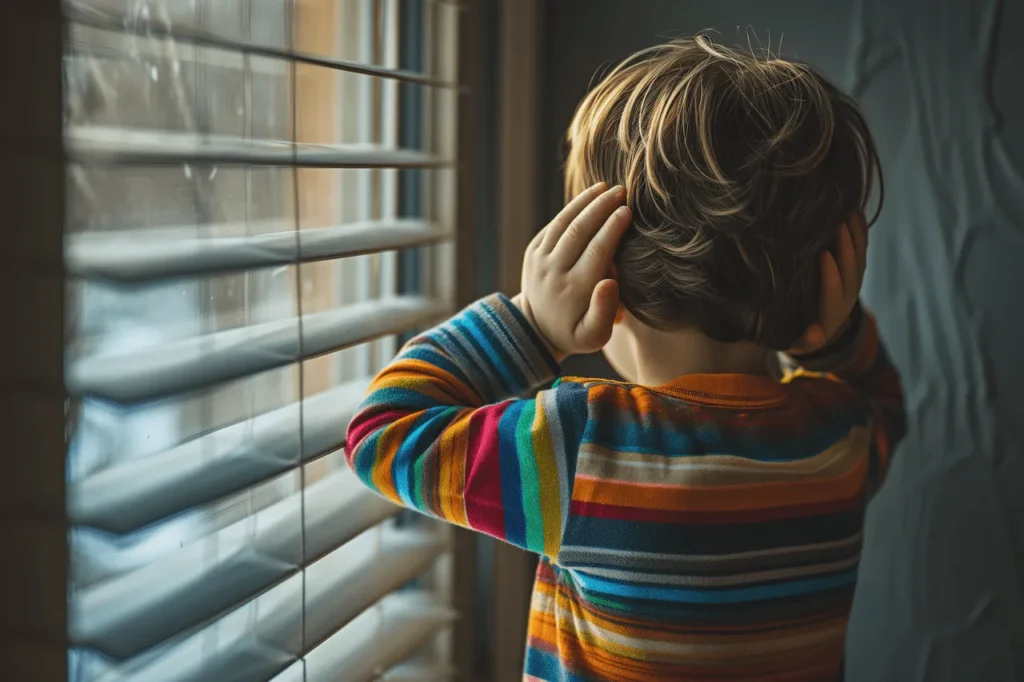
It is no longer just crying (as with a baby). The child covers their ears, refuses to touch certain fabrics or won’t try food with an unusual texture (they become very fussy eaters).
During this period, difficulties in understanding other people’s emotions also become increasingly apparent. A child may look at a classmate who is crying but show no concern or surprise, or fail to recognise a change in a parent’s or teacher’s tone of voice as part of the message.
Do you need some help?
Diagnosis of autism at the Dialog Centre for Children and Families
We carry out a comprehensive psychological assessment of the autism spectrum — thoroughly, providing a complete picture of the child’s potential and recommendations for the school.
The various manifestations of autism spectrum disorders in infants and young children
Just a dozen or so years ago, children and adults were diagnosed with various conditions – childhood autism, atypical autism, Asperger’s syndrome or pervasive developmental disorders. Nowadays, in accordance with the classifications of the World Health Organisation (ICD-11) and the American Psychiatric Association (DSM-5), a single term is used: autism spectrum disorder. This change in definition was deliberate and well-considered – it has made it possible to better capture the diversity of developmental trajectories among children with this diagnosis.
- The term ‘spectrum’ emphasises that symptoms can vary widely – ranging from mild, barely noticeable differences in development to profound difficulties in communication and social interaction, which may be accompanied by symptoms of intellectual disability.
No two people on the autism spectrum are exactly the same. Among children, differences are observed not only in the severity of symptoms but also in their ‘combination’, which forms the individual picture of the condition. Although we have already pointed this out, it is worth emphasising it clearly.
- Infants and children may develop speech normally whilst at the same time experiencing difficulties in social interactions. Others start speaking later, but are able and willing to maintain eye contact or respond to those close to them.
That is why an individualised approach is so important – the diagnostic process is not based on the confirmation of a single symptom, but on the overall clinical picture. At the Dialog Centre for Children and Families, we take an individualised approach to diagnosis and therapy. Our specialists use appropriate diagnostic tests, questionnaires and tools which, even in early childhood, enable us to develop methods tailored to the young patient’s individual characteristics.
Autism spectrum disorders in teenagers
Conversations within the peer group flow easily; they’re full of jokes, irony and innuendo that most young people understand without difficulty. A teenager on the spectrum stands nearby, trying to make sense of what is being said. He wonders when he should laugh and how to keep the conversation going. Every slip-up reinforces the impression that he is speaking a different language. Although he craves connection, the barrier of misunderstanding creates a sense of alienation and pushes him to withdraw.
- This is what life might be like for a young person who is experiencing some of the symptoms of autism spectrum disorders.
It is precisely during this period that differences in peer relationships become particularly apparent. Teenagers on the spectrum often crave social contact, but do not know how to keep a conversation going, pick up on the hidden meanings in what is said, or understand subtle non-verbal cues.
The intensity of emotions during adolescence, combined with autism spectrum disorders, can sometimes be difficult to manage. Sudden outbursts of anger, frustration or emotional overload may be more pronounced than in previous years. Some teenagers are also at greater risk of developing secondary anxiety or depressive disorders, as they begin to recognise the differences between themselves and their peers more clearly.
At this age, education becomes a tool for development and a way of building self-awareness. When a young person with autism understands where their reactions come from and why certain situations are more difficult for them, they find it easier to accept their own differences. Knowledge helps to make sense of experiences – it makes it easier to talk to family, teachers and peers.
Do you need some help?
Diagnosis of autism at the Dialog Centre for Children and Families
We carry out a comprehensive psychological assessment of the autism spectrum — thoroughly, providing a complete picture of the child’s potential and recommendations for the school.
FAQ – symptoms of autism in children – what do you need to know about autism spectrum disorders?
What are the early signs of autism spectrum disorder?
Children on the autism spectrum experience symptoms that vary depending on the severity of the disorder. In some, the first signs are visible very early on (e.g. in the way they respond to contact with a parent), whilst in others they only become noticeable at the age of 2 (e.g. they may relate to communication or the way they play).
Is a single symptom enough to diagnose autism?
No. The diagnosis is based on a whole range of observations and specialist tests. A single characteristic – such as delayed speech development – does not determine the diagnosis. In a comprehensive assessment, the psychiatrist takes into account various areas of the child’s functioning – communication, relationships, repetitive behaviours and responses to stimuli.
Can a child display autistic traits without being on the autism spectrum?
Yes. Anyone may display individual traits typical of the spectrum, such as a preference for routine or exceptional sensory sensitivity. However, the diagnosis is not determined by the mere presence of such behaviours, but by how they affect day-to-day functioning and development. A child with isolated traits does not always meet the criteria for autism spectrum disorders.
Are there any specific behaviours that rule out autism?
There is no single behaviour that automatically ‘rules out’ a diagnosis. Many children on the spectrum make eye contact, are able to speak in full sentences or show an interest in their peers. Autism is a spectrum disorder. Symptoms vary in severity and occur in different combinations.
Why is the stereotypical view of an autism diagnosis unfair?
The stereotype that ‘a child with autism lives in their own world and isn’t interested in others’ does not reflect reality. Many people on the spectrum crave connection, but express it in a different way. Clinging to a simplified view prevents the early detection of disorders. All too often, we still view things through the lens of the stereotypical image of a ‘person with autism’, rather than recognising our child’s individual characteristics.
Bibliography
- Gerc, K., & Jurek, M. (2019). Autism spectrum disorders from the perspective of differential diagnosis. Eruditio et Ars, 1(2), 30–38.
- Winczura, B. (2019). Early recognition of autism in young children – warning signs for the diagnosis of autism spectrum disorders. Psychiatry and Clinical Psychology, 19(2), 216–225.
- Rybakowski, F., Białek, A., Chojnicka, I., Dziechciarz, P., Horvath, A., Janas-Kozik, M., … & Dunajska, A. (2014). Autism spectrum disorders – epidemiology, symptoms, comorbidity and diagnosis. Psychiatria Polska, 48(4).
- Agnieszka, S., & Anna, W. (2020). Feelings of loneliness among adolescents with autism spectrum disorders. Educational Psychology, 59 (17), 41–50.
- Wrona, S., & Józefacka, N. (2021). Early symptoms of autism spectrum disorder: a review of the research. Edukacja Quarterly, 157(2).
- Winczura, B. E. (2024). Early indicators of autism in young children during interactions with their parents. Wychowanie w Rodzinie, 31(3), 213–232.
Read more
Related articles
The Autism Spectrum in Girls
A word of introduction In the 1970s, the British psychiatrist Lorna Wing observed that if a child exhibits various difficulties in three areas: then we can talk about autism. The Autism Spectrum We are talking about the autism spectrum, which means that symptoms and the severity of difficulties can vary significantly from person to person. […]

How can you recognise autism in a young child?
Early-childhood autism, now referred to as autism spectrum disorder (ASD), is a complex neurodevelopmental disorder that affects the way a child perceives the world, communicates and forms social relationships, as well as their behaviour and responses to environmental stimuli. We talk about the autism spectrum in children because the symptoms and their severity can vary […]
Social skills training for children
Social Skills Training, abbreviated to TUS, can be described, in the simplest terms, as active therapy in the form of workshops, which are conducted in groups of people of a similar age or with a similar level of functioning. The aim of TUS is to develop emotional and social skills through modelling (i.e. learning by […]

Psychomotor development (children aged 0–3 years)
A child’s psychomotor development is a process in which the child develops both their mental and motor skills during the first three years of life. This is a period of rapid change, during which a child reaches many milestones in the development of their motor, cognitive and social skills. During the first three years of […]

Snoezelen, or the Sensory Room
1. Introduction The senses form the basis of every person’s development. They provide information about the world around us. Without them, none of us could develop. However, some people are unable to respond to them appropriately, whilst others have lost these abilities due to an accident or illness. For these people, the world can be […]

Early speech and language therapy intervention – A newborn baby sees a speech and language therapist.
Early speech and language therapy intervention: a newborn’s first visit to a speech and language therapist There are many factors which have an adverse effect on a child’s speech development and subsequent functioning. The earlier any abnormalities are identified, the quicker and more effective speech and language therapy may prove to be. Special speech and […]
Do you need some help?
Diagnosis of autism at the Dialog Centre for Children and Families
We carry out a comprehensive psychological assessment of the autism spectrum — thoroughly, providing a complete picture of the child’s potential and recommendations for the school.
Book a consultation