



Contents:
A psychiatrist is a doctor who specialises in diagnosing and treating mental, behavioural and emotional disorders. There are situations in which it is particularly advisable to be under the care of a psychiatrist or to undergo pharmacological treatment. A psychiatrist can diagnose mental disorders such as depression, anxiety disorders, obsessive-compulsive disorder, eating disorders, and neurodevelopmental or organic disorders.
A doctor specialising in this field can also help with difficult life situations, such as sudden or chronic stress, difficult relationships or behavioural disorders. In some cases, medication is also recommended or advised.
What myths about psychiatry and pharmacological treatment need to be debunked:
- Stereotypes and prejudices: Many people still believe that treatment with medication is a sign of ‘laziness’ and a lack of commitment on the patient’s part, or that there is no hope of improvement. Many people are also concerned about the unfair stereotype of the psychiatrist, whose patients are ‘mad’.
- Lack of awareness of effectiveness and fear of side effects: Some people are unaware that medication can be effective in treating many mental health conditions. Furthermore, they are concerned about side effects, which are sometimes unavoidable but are also temporary or can be managed by changing the medication or adjusting the dosage.
- Misleading information: misinformation about drug treatment and its usefulness or effectiveness, as well as anecdotal evidence regarding medical appointments, can lead to a reluctance to use such treatments.
- The push for ‘naturalness’: Some people confuse medical treatment with natural methods of supporting the body when it is struggling – such as meditation, taking supplements or physical exercise – and consequently regard drug treatment as unnatural.
Do you need some help?
Child psychiatrist at the Dialog Centre for Children and Families
Experienced child psychiatrists — diagnosis and treatment of mental health disorders in children and adolescents, including pharmacotherapy.
Despite these difficulties, pharmacological treatment can be an effective way of helping people cope with many mental health conditions, and it is worth discussing this option with a specialist – a psychiatrist or a child and adolescent psychiatrist. It is also worth recognising the significant role of pharmacological treatment under the supervision of a psychiatrist as a method that actively supports (and often facilitates) psychotherapy and helps to clarify the patient’s problem.
Neuroscience now enables us to identify quite precisely which areas of the brain are overactive or underactive, which in turn helps to further support therapeutic interventions. We therefore now have the ability to carry out comprehensive diagnosis and plan effective treatment, including pharmacological treatment. Pharmacotherapy is often one of the most effective and rapid forms of both immediate and long-term relief. Medication helps to stabilise the patient’s condition and, in the longer term, enables more effective work on their problems or disorders. However, it is always important to remain under the supervision of a specialist.
Medicines help to calm or stimulate the body and, in this way, support the therapeutic process (alongside the general functioning of the child or adult) – this is a very good starting point, for example, for effective psychological therapy or psychotherapy. This is because the human body often needs pharmacological support in order to actively engage with the therapeutic process at all:
- A child who has difficulty concentrating or is hyperactive often needs, first and foremost, to be calmed down so that they can work effectively and so that their brain can focus on the task at hand,
- In turn, we will encourage the teenager, who is experiencing reduced activity, to boost their motivation and thereby support the therapeutic process
- Often, aggression in children is a manifestation of pituitary hyperactivity, which must first be brought under control with medication to enable work to begin with an aggressive patient.
Read more
Related articles

Support for children with speech disorders
Speech disorders are various types of communication problems that can make it difficult for a child to interact with other people. They include problems with: In children, speech disorders can affect their emotional and social development, which often leads to feelings of isolation and frustration. Speech disorders in children are a problem that can take […]

Social skills training for children
Social Skills Training, abbreviated to TUS, can be described, in the simplest terms, as active therapy in the form of workshops, which are conducted in groups of people of a similar age or with a similar level of functioning. The aim of TUS is to develop emotional and social skills through modelling (i.e. learning by […]
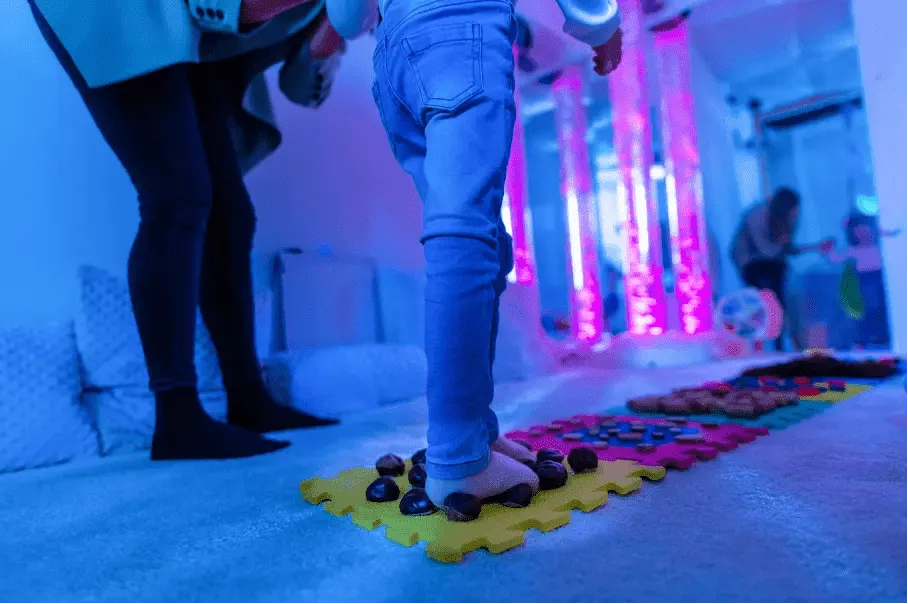
Sensory Integration in the Snoezelen Room
A sensory room, also known as a ‘Snoezelen sensory room’ or simply a ‘Snoezelen room’, is a specially designed space intended to create an environment that stimulates the senses whilst providing a sense of safety and relaxation. These rooms are often used when working with people with a range of needs, including those with developmental […]

Psychomotor development (children aged 0–3 years)
A child’s psychomotor development is a process in which the child develops both their mental and motor skills during the first three years of life. This is a period of rapid change, during which a child reaches many milestones in the development of their motor, cognitive and social skills. During the first three years of […]

Snoezelen, or the Sensory Room
1. Introduction The senses form the basis of every person’s development. They provide information about the world around us. Without them, none of us could develop. However, some people are unable to respond to them appropriately, whilst others have lost these abilities due to an accident or illness. For these people, the world can be […]

Auditory processing – What are auditory processing disorders and how can they be treated?
Have you ever wondered how the ability to listen – rather than simply hear – affects a person’s overall development? The ear is not just for hearing. It also stimulates the brain and helps maintain balance. Good hearing plays a key role in the development of a person’s personality. Problems arise when we are dealing […]
Do you need some help?
Child psychiatrist at the Dialog Centre for Children and Families
Experienced child psychiatrists — diagnosis and treatment of mental health disorders in children and adolescents, including pharmacotherapy.
Book an appointment