


Would you like to nurture your child’s musical development and natural sensitivity from a very young age?
Book them onto:
Gordonki
Musical education in cognitive development
Course dates
| Monday | Tuesday | Wednesday | Thursday | Friday | |
|---|---|---|---|---|---|
| 10:00 |
Gordonki – 45 min 0–18 months Katarzyna Belkius ul. Cybernetyki 3C |
||||
| 11:00 |
Gordonki – 45 min 0–18 months Katarzyna Belkius ul. Cybernetyki 3C |
||||
| 12:00 | |||||
| 13:00 | |||||
| 14:00 |
Gordonki – 45 min 0–18 months Katarzyna Belkius ul. Cybernetyki 3C |
||||
| 15:00 |
Gordonki – 45 min 0–18 months Katarzyna Belkius ul. Cybernetyki 3C |
Monday
No classes
Tuesday
Gordonki
–
45 min
0–18 months
Katarzyna Belkius
ul. Cybernetyki 3C
Gordonki
–
45 min
0–18 months
Katarzyna Belkius
ul. Cybernetyki 3C
Wednesday
Gordonki
–
45 min
0–18 months
Katarzyna Belkius
ul. Cybernetyki 3C
Gordonki
–
45 min
0–18 months
Katarzyna Belkius
ul. Cybernetyki 3C
Thursday
No classes
Friday
No classes
Gordonki – Warsaw
The world of sound accompanies a child from the very earliest stages of development, even before birth. It is at this stage that they begin to recognise rhythm, melody and the sounds of their surroundings, which form an important foundation for their future development.
Exposure to music from the very first months of life fosters a natural ability to perceive and understand it. Musical development is not about learning, but about gradually familiarising the child with sound, rhythm and melody.
Gordonki are classes that help children develop their musical sensitivity and an intuitive understanding of music through active listening, movement and shared experiences.
Why choose Gordonki?
Sensory-motor development
Musical education is not just about exposure to music, but also about supporting a child’s overall development. The classes help to develop a sense of rhythm, motor coordination, memory, and speech and diction.
The Gordon Method is based on the natural integration of sound with movement and sensory experience. This enables children to develop their motor skills and learn to respond to stimuli in a more conscious and organised manner.
Shaping social interactions
The sessions help to build relationships and a sense of security. By taking part in them alongside a carer, the child experiences a sense of closeness, learns to cooperate and gradually becomes more familiar with their own body and the space around them.
Sharing the experience of music, movement and emotions helps to build bonds and reinforces positive relationship patterns.
Shaping attitudes
The Gordon method is based on freedom and following the child’s lead. The absence of rigid structures allows for natural exploration and the development of curiosity about the world.
The child has the space to express themselves, experiment and explore, whilst carefully selected stimuli support their engagement and sense of agency.
What are Gordonki?
Gordonki are music education classes based on the theory of music learning developed by Edwin E. Gordon. Their aim is not to teach children to sing or play instruments, but to develop their ability to understand music in a way that comes naturally to a child.
During the sessions, children explore music through listening, movement and experience, learning to distinguish between rhythms, melodies and musical patterns. A key concept in this method is ‘audiation’, which is the ability to hear and understand music internally.
The classes are tailored to the child’s stage of development, thereby supporting their natural aptitudes and gradually developing their musical sensitivity.

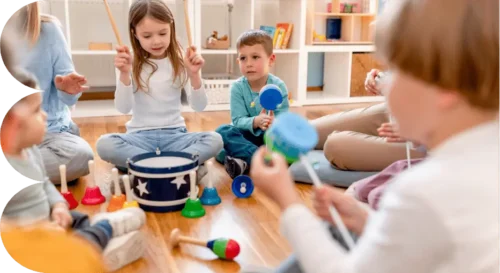
Gordonki at the Dialog Centre for Children and Families
We create an environment in which children can freely experience music through a variety of sounds, rhythms and melodies. This exposure helps to develop their musical ear and a natural sensitivity to music.
During the sessions, we use singing, movement, simple rhythmic activities and a variety of instruments and props to help the children engage with the musical experience. The sessions take the form of a relaxed, friendly exploration, tailored to each child’s abilities and pace of development.
At Dialog, we take particular care to ensure that a child’s experience of music is a source of joy and curiosity, whilst also supporting their development.
The classes are aimed at children aged 0 to 3 years
Enrol your child in:
Gordonki
The world of sound accompanies a child from the very earliest stages of development, even before birth. It is at this stage that they begin to recognise rhythm, melody and the sounds of their surroundings, which form an important foundation for their future development.
You can trust us
A child’s first experiences of music and their relationship with a carer are of great importance to their development and sense of security.
That is why, at the Dialog Centre for Children and Families, sessions are led by experienced therapists and facilitators who specialise in working with very young children. We ensure a safe, supportive atmosphere and provide attentive support to both the child and the parent throughout this shared experience.
Articles
Have a look at our articles on this topic
Social skills training for children
Social Skills Training, abbreviated to TUS, can be described, in the simplest terms, as active therapy in the form of workshops, which are conducted in groups of people of a similar age or with a similar level of functioning. The aim of TUS is to develop emotional and social skills through modelling (i.e. learning by […]

Psychomotor development (children aged 0–3 years)
A child’s psychomotor development is a process in which the child develops both their mental and motor skills during the first three years of life. This is a period of rapid change, during which a child reaches many milestones in the development of their motor, cognitive and social skills. During the first three years of […]

Snoezelen, or the Sensory Room
1. Introduction The senses form the basis of every person’s development. They provide information about the world around us. Without them, none of us could develop. However, some people are unable to respond to them appropriately, whilst others have lost these abilities due to an accident or illness. For these people, the world can be […]


