


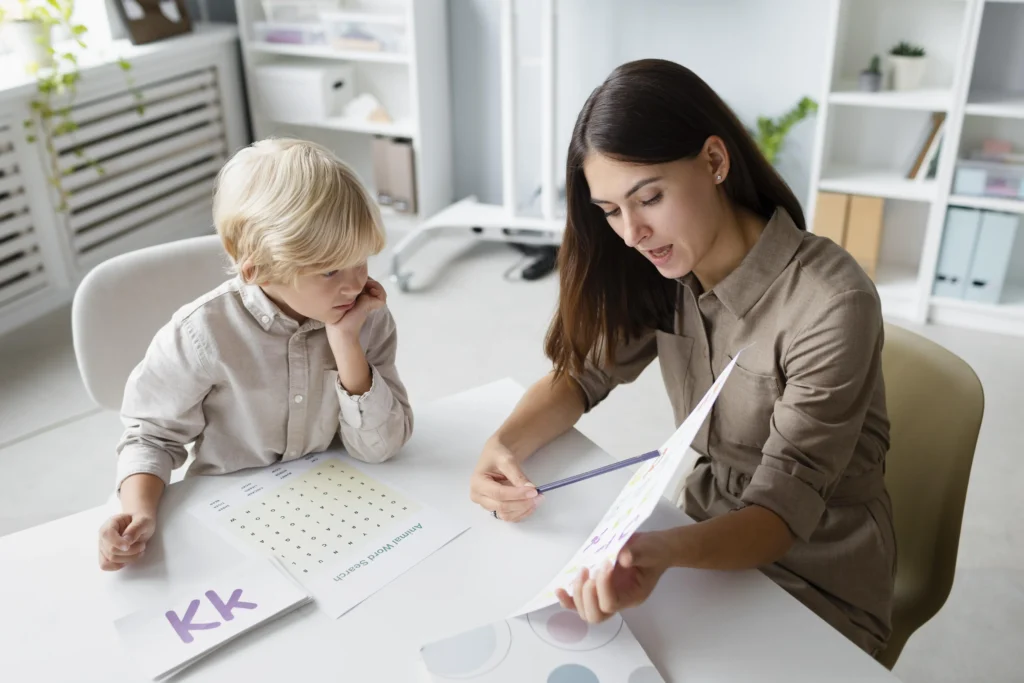
Difficulties with writing or learning do not have to undermine a child’s self-confidence
Educational therapy for children and young people
How it works
What is educational therapy?
Educational therapy consists of individually tailored sessions for children and teenagers who need support with learning to write or who are facing specific difficulties at school. Regular sessions with a specialist help to develop the necessary skills, learn more effective learning strategies and gradually regain the confidence that learning can be easier.
At the Dialog Centre for Children and Families, we offer educational therapy in two forms:
Hand therapy
Hand therapy aimed at learning and improving handwriting.
Therapy for learning difficulties
Therapy for learning difficulties in children and teenagers diagnosed with dyslexia, dyscalculia, dysgraphia or dysorthography.
We always tailor the content of our sessions to the child’s age, diagnosis, abilities and current needs.
Course
Two forms of educational therapy
Choose the support that’s right for your child
1. Hand therapy – learning and improving handwriting
Hand therapy is designed for children who find it difficult to master writing techniques, who write slowly or illegibly, whose hands tire quickly, or who experience discomfort whilst performing graphomotor tasks.
The sessions are not limited to hand and finger exercises. Correct writing requires a stable posture, a mobile shoulder girdle, appropriate control of muscle tone and good eye-hand coordination.
Therefore, the therapy also includes whole-body exercises, with particular emphasis on the shoulder girdle, arms and forearms.
During hand therapy, we focus, amongst other things, on:
- stabilisation of posture and the shoulder girdle,
- strengthening the arms, forearms, hands and fingers,
- the correct grip on a writing implement,
- applying the right amount of pressure with a pen or pencil on the sheet of paper,
- hand-eye coordination,
- the dexterity and precision of hand movements,
- fluency, pace and legibility of handwriting,
- the correct positioning of the body, hand and sheet of paper whilst writing,
- planning the movements required to form letters,
- stamina during longer writing tasks.
2. Therapy for learning difficulties
Therapy for learning difficulties is designed for children and teenagers diagnosed with dyslexia, dyscalculia, dysgraphia or dysorthography. The scope of the therapy is determined by the diagnosis and the recommendations set out in the assessment report, whilst the objectives are tailored to the young person’s actual needs and stage of education.
During therapy, the child develops the skills and abilities needed to read, write, do maths and learn more effectively. They also learn strategies to help them compensate for their difficulties and cope better with the demands of school.
Depending on the diagnosis, during the sessions we work on:
- reading technique, fluency and comprehension,
- auditory and visual analysis and synthesis,
- the correct spelling of words and sentences,
- reinforcing spelling rules and applying them in practice,
- legibility, pace and organisation of the writing,
- understanding of mathematical concepts,
- the ability to carry out activities and solve word problems,
- spatial awareness and an understanding of numerical relationships,
- memory, concentration and the organisation of study material,
- work planning and the selection of effective learning strategies,
- independence and building confidence in one’s own abilities.
Which form of therapy will be suitable?
Hand therapy will be the right choice when the main difficulty is:
- learning the shape and how to write letters,
- holding a pen or pencil incorrectly,
- applying too much or too little pressure to the paper,
- slow, illegible or tiring handwriting,
- pain or rapid fatigue in the hand whilst writing,
- poor posture at a desk,
- reduced function of the shoulder girdle, arms, hands or fingers,
- difficulty with eye-hand coordination.
Therapy for learning difficulties is the right choice when a child:
- has been diagnosed with dyslexia and has difficulties with reading or comprehending text,
- He has been diagnosed with dysorthography and makes numerous spelling mistakes despite knowing the rules,
- has been diagnosed with dysgraphia and needs support with writing and completing written tasks,
- has been diagnosed with dyscalculia and has difficulty understanding numbers, carrying out calculations or solving problems,
- needs to follow the recommendations set out in the diagnostic report on a regular basis,
- finds it difficult to choose effective learning strategies and to organise their own work.
If a child’s difficulties involve both the technical aspects of writing and broader academic problems, a specialist may suggest combining elements of both forms of therapy.
Step by step
How does educational therapy begin?
Understanding a child’s needs
Before regular lessons begin, the teacher familiarises themselves with the assessment, recommendations and information provided by the parent. It is a good idea to bring along the report from the counselling centre, previous test results and examples of exercise books, written work or materials showing the areas in which the child has the greatest difficulty.
We set the goals for the therapy
The specialist identifies the key areas for work and tailors them to the child’s age, abilities and current stage of education. Objectives may include, amongst other things, improving writing technique, increasing reading fluency, reducing spelling mistakes or developing mathematical skills.
We are starting our regular classes
The exercises are selected on an individual basis and graded so as to present the child with an achievable challenge. The sessions combine the development of necessary skills with the practical application of these new skills in schoolwork.
We are monitoring progress
The teacher monitors the child’s development and adapts the work plan as and when necessary. Parents are kept informed about the objectives being worked on and are given advice on how to support their child between sessions.
Consultation
A consultation may be a one-off meeting or the start of a longer-term relationship. It all depends on the child’s situation and the reason the family has come forward.
Therapy for learning difficulties
Support tailored to the child’s diagnosis




Starting early helps to minimise the development of bad habits and makes writing less of a struggle for the child.
Why choose us?
Why should you choose educational therapy
at the Dialog Centre for Children and Families?
Articles
Have a look at our articles on this topic
What is dysorthography? Symptoms, causes and treatment methods.
Not every typo is down to a lack of care, and not every spelling mistake is the result of rushing. Dysorthography affects thousands of children who know how to follow the rules of correct spelling but are unable to put that knowledge into practice. Why is that? What is dysorthography? What are its symptoms and […]